

Workplaces are being transformed by artificial intelligence (AI), sustainability and governance and reporting requirements, and the World Economic Forum calculates that 39 per cent of the skills needed in today’s jobs will be obsolete or transformed by 2030.
But Mairéad Nic Giolla Mhichíl, associate professor and head of the National Institute for Digital Learning at DCU, says that this figure is probably best considered as a conservative benchmark, not a ceiling.
“The pace of change we are experiencing from digitalisation, artificial intelligence and the green transition is increasing in momentum,” she says.
“We expect these global trends to touch and to transform many activities within most roles and across every sector. Ireland has a high concentration of knowledge-intensive sectors, small to medium-sized enterprises (SMEs) and, as we are currently witnessing, a particular sensitivity to global supply, energy and value chains.
READ MORE


“Taking this into account, I would expect that a higher number of workers need skills renewal and skills engagement in Ireland. Fundamentally, we need to shift our thinking from one-off retraining to continuous lifelong learning being a normal part of life for all workers in Ireland.”
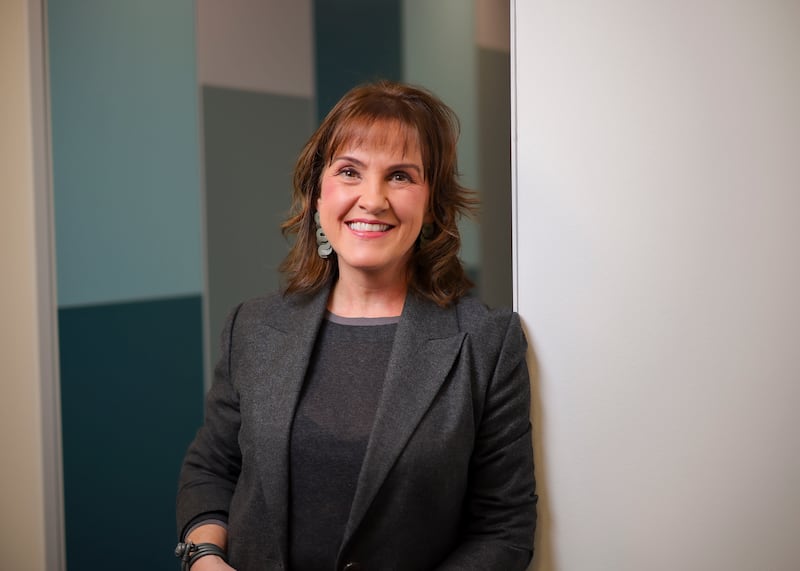
Alison Hodgson, country director of CIPD Ireland, the professional body for HR practitioners, says that the effects of this disruption on the labour market may take decades to materialise.
“The impact on job changes and displacement is a gradual process, rather than a big-bang event,” she says. “The phone was invented in 1876, but it took decades for the impact to hit. Jobs declined in the telegram and telegraph industries over the decades but, at the same time, over half a million jobs were created, including the new role of telephone operator.”
Hodgson suggests something similar is happening today.

“We are seeing work pushed higher up the value chain,” she says. “We have traditionally seen a pyramid structure with a large number of entry-level jobs. Now the pyramid is becoming a diamond, with entry-level jobs fewer and more jobs in the middle of the organisation.”
So, who exactly is the typical lifelong learner? Nic Giolla Mhichíl notes that participation in learning now spans all age groups, career and life stages, driven by very different motivations.
Mary Lyons, director of enterprise, employees and skills at Solas, the further education and training authority, says data from the organisation’s Skills to Advance programme shows an even spread across age groups up to about 55, after which participation drops.
“We need to reach those older workers to encourage people to stay longer in the workforce, given the tight labour market and people’s personal economic constraints,” Lyons says.
But, whatever the age and stage of any given learner, there have always been barriers to upskilling and reskilling.
Cost remains the most significant deterrent, particularly for lower-paid workers and employees in smaller companies. Many people are simply uncertain about which skills they need or how to navigate the array of available options.
A course is also a significant time commitment. This is why providers have moved to make learning opportunities as flexible as possible, particularly by providing online and blended learning options and pre-recorded lectures which can be watched in a learner’s own time.
Who should pay for this? Lyons, Hodgson and Nic Giolla Mhichíl all agree that the costs, financial and otherwise, should be borne by learners, employers and the State.
“Employers have to pay to take people off the day-to-day job in order to learn,” says Hodgson. “The Government needs to provide funding for Skillnet and apprenticeship programmes. And the individual will need to learn in both their own time and on the company clock.”
Nic Giolla Mhichíl says supports such as Springboard and the learner fee subsidy for microcredentials are useful, but she cautions that they can come with significant administrative overheads.
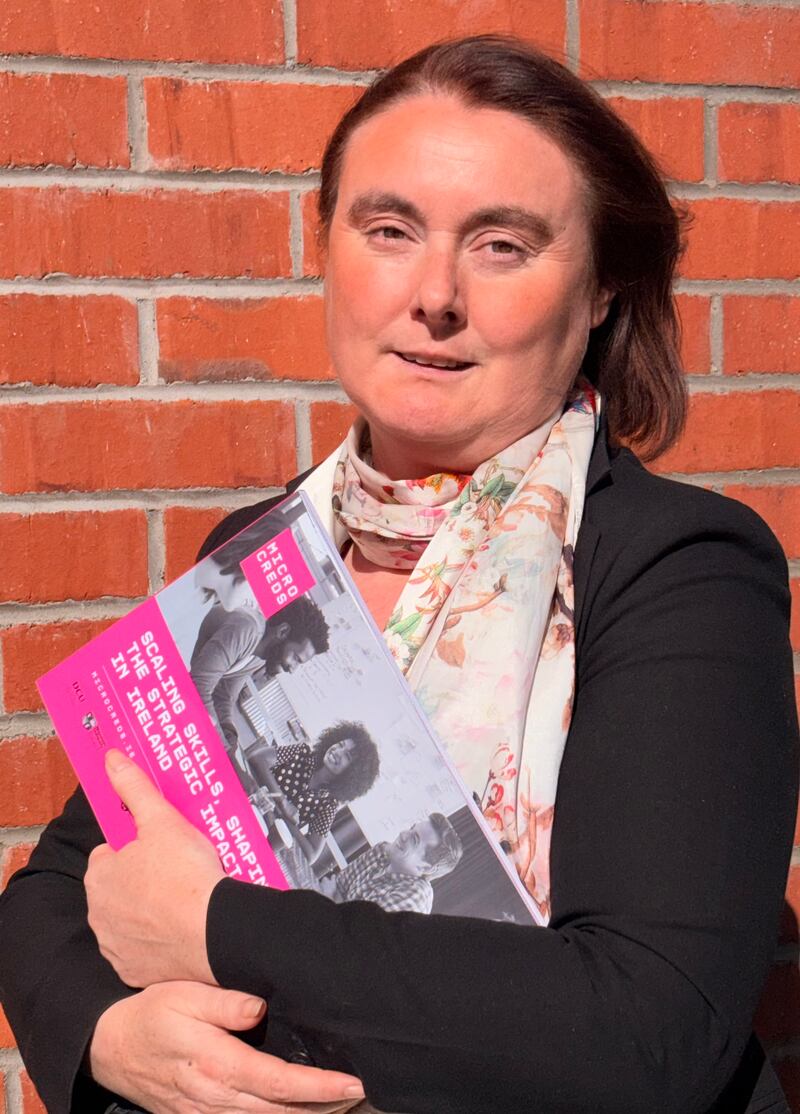
“The real cost of delivering these courses for many education and training institutions is not being realised, and learners are being required to submit substantial documentation to qualify,” she says.
Indeed, microcredentials – short, accredited modules that can typically be completed in about 50 hours – are increasingly central to this conversation. Awareness among employers has grown substantially, driven by stakeholders from regional and national skills councils to Skillnet Ireland and employers’ group Ibec. DCU alone has engaged with hundreds of employers in developing its microcredential offerings.
But, Nic Giolla Mhichíl says, there is still a long way to go.
“We are still some way from the point where microcredentials are placed on a par with longer qualifications due to ingrained familiarity with these in some sectors,” she says.
According to the 70/20/10 model of learning development, the majority of professional learning happens on the job, with 20 per cent taking place through interactions such as mentoring and networking, and just 10 per cent of learning developed through formal training.
Hodgson, however, says that ratio is moving closer to 90 per cent experiential, with formal courses playing an ever-smaller formal role.
Lyons notes that Solas has seen workers combine microcredentials in ways that were not anticipated, building and combining their own skill sets across digital, sustainability and AI modules rather than following prescribed pathways.
For all the complexity of the policy and funding landscape, Hodgson returns to something simpler. “Learning almost always answers everything in life, not just business,” she says.
So, the learning infrastructure exists; the challenge now is to scale it quickly enough and fairly enough to matter.


