
A group of Irish and Italian scientists are celebrating after their mission to capture the total solar eclipse succeeded off the west coast of Ireland.
Thirteen crew and scientists left Baldonnel in Dublin on the Irish Air Corps C295 at 3pm on Wednesday. Their goal was to chase the eclipse.
As they travelled out to sea, they searched around for a break in the cloud. They eventually found it 550km directly west of Galway in the path of the total eclipse.
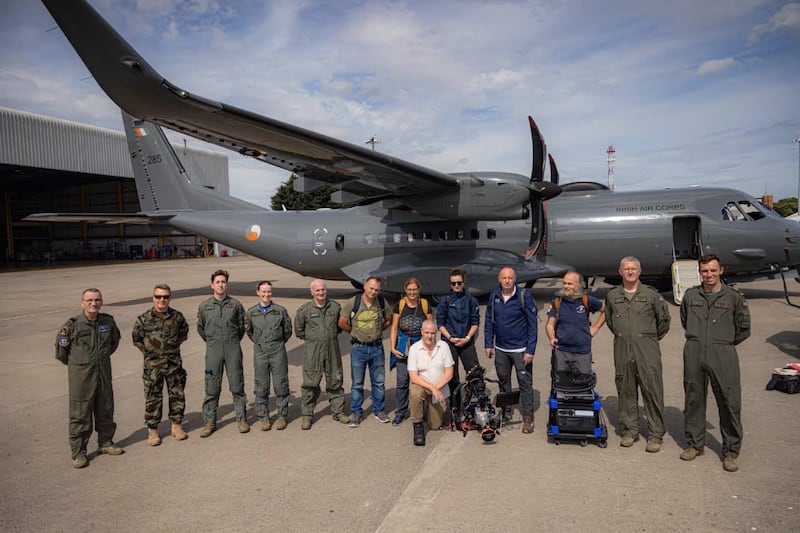
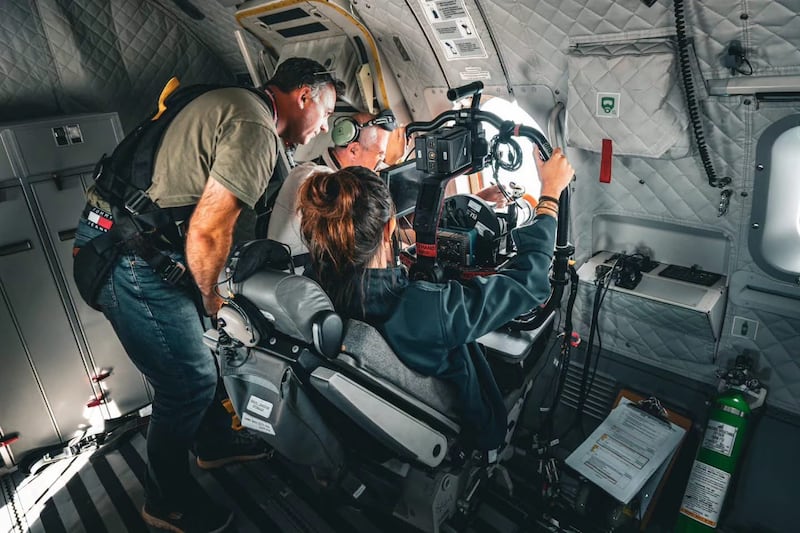
Their mission involved capturing the total eclipse through a special solar telescope. This would be achieved by pointing the telescope out the window of the aircraft.
READ MORE


“There was a huge bank of clouds on the west coast and out to sea,” said Prof Peter Gallagher, the head of astrophysics and director of Dunsink Observatory at the Dublin Institute for Advanced Studies (DIAS).
“We spotted a gap in the clouds a couple of hundred kilometres wide and it coincided with the eclipse. The weather gods were on our side."
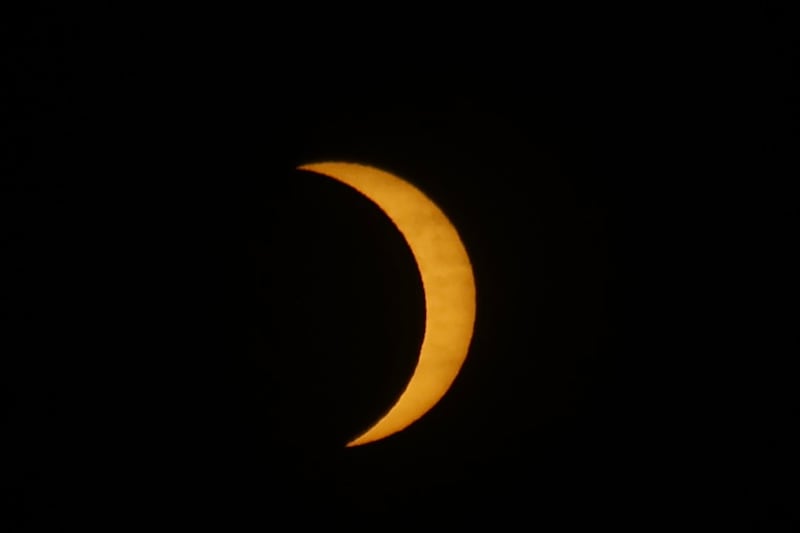
The team captured one minute and 50 seconds of totality. They needed just one minute to get the scientific data required.
“We are ecstatic about it. There was a lot of high-fiving. It was like Nasa after a successful rocket launch.”
Gallagher said the Air Corps’s new Airbus C295 provides a much more stable environment than its predecessor. A similar mission in 2015 did not work out as well.
[ Even Dublin’s seagulls took a moment to pause as the solar eclipse filled the skyOpens in new window ]
Onboard the aircraft this week were researchers from DIAS, Trinity College Dublin, Technological University Dublin and Italy’s National Institute for Astrophysics.
Their mission is to understand why the corona, the outer layer of the sun, is so hot compared to the interior of the sun.
They have already viewed the preliminary data. “It looks really good. We have optical images, we have infrared images and we have what is called green-line images,” said Gallagher.
“Between them we should be able to work out the sun’s temperatures and the magnetic field of the sun’s atmosphere. It might take a year before we publish a scientific paper on it.”
The Dunsink Observatory, which hosted an eclipse party on Wednesday evening, was involved in a world-class experiment in 1919 which proved that Albert Einstein’s Theory of Relativity was correct.

On May 29th 1919 British astronomers travelled to Brazil to photograph the total eclipse.
It turned out that the most accurate measurements were obtained in the Brazilian city of Sobral. This was carried out using Irish-made instruments, one of which was made by engineer Howard Grubb in Rathmines, Dublin. That expedition was led by astronomer Andrew Crommelin from Cushendun, Co Antrim.
When the results were finally announced, they made the front page of the New York Times with the headline “Lights all Askew in the Heavens, Einstein Theory Triumphs”. It made Einstein a household name.


