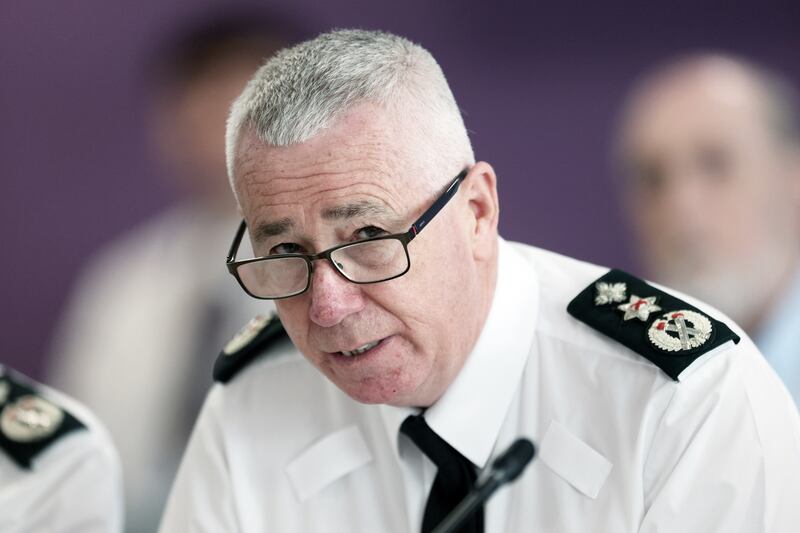
Earlier this year, Police Service of Northern Ireland (PSNI) Chief Constable Jon Boutcher and former Garda commissioner Drew Harris visited a school in the Derry and Strabane area.
Recalling the trip before the Northern Ireland Affairs Select Committee in Westminster in March, Boutcher said they gave a presentation to teenagers from different community backgrounds and likened it to “planting … trees for the future”.
He described it as a “fabulous” experience, but said there was also “quite a huge police presence” as “there had been a dissident republican threat”.
“Those schoolchildren … saw this very visible policing presence, which obviously is disconcerting,” he said. “Psychologically, that just is not where we want to be.”
READ MORE


However, it is exactly where the armed dissident republican groups want to be. In recent months they have been highly visible, with attacks on two Northern Irish police stations and the interception of what gardaí described as an “extremely significant” bomb near the Border – all attributed to the New IRA.

In March, what police said was “a crude but viable improvised explosive device” was placed inside a hijacked car and the driver was ordered to take it to Lurgan police station, where a controlled explosion had to be carried out.
In April, a hijacked car with a gas cylinder inside exploded outside the police station in Dunmurry, Co Antrim, as PSNI members were evacuating the homes of local people.
In July, as part of an “intelligence-led” operation, gardaí stopped a car near Carrickmacross, Co Monaghan, with a bag inside containing Semtex and a detonator. The target was understood to be the police station in Derry.
Isobella Perrie Sullivan (25), a law student from Abbeylands Park, Clane, Co Kildare, was arrested and charged with possession of explosives. A second individual, Simon O’Donovan (44), of Sperrin Road, Drimnagh, Dublin, has been charged with possession of an explosive substance.

This week, Óglaigh na hÉíreann claimed – on the front page of The Irish News – that it had tried to kill a loyalist in Belfast earlier this month.
The dissident groups “want their presence known,” according to Marisa McGlinchey, assistant professor of political science at Coventry University.
“They’re always trying to recruit, they’re always armed. They know they’re not capable of a large-scale campaign, but what they know they can do is the occasional incident, like what they have been doing, and that’s just to remind people they’re still here,” she says.
The groups are also “really keen to target the police”, McGlinchey says. “They don’t want the police to ever be in a situation where they feel like they’re in a normal society.”
The official assessment of the threat level in Northern Ireland is “substantial”, meaning an attack is “likely”, Boutcher told that same Westminster committee in March. The “aspiration”, he added, is to get down to “moderate” by 2030.
“My view is that we are at the low end of ‘substantial’ because of the way that we have managed to suppress this threat, but the threat exists,” he said. “A lot of these people are currently in prison. We are constantly having successes against them.”
Dr Jonny Byrne, senior lecturer in criminology at Ulster University, says the security services appear “to be very confident, and they seem to be very on top of things”.
“Nobody’s egging up the threat in the North. Nobody’s saying ‘we need to be careful, there’s a new wave of armed violence coming’. There seems to be a sense of control around the security response to these issues,” he says.
The interception at Carrickmacross, Byrne says, “gives the impression that was being observed from the beginning. It wasn’t just random.”
PSNI statistics show a 10-year trend. In 2016/17, there were five security-related deaths, 29 bombing incidents and 61 shooting incidents. In 2025/26, there were no deaths – the last coming 2½ years ago – 19 bombings and eight shootings.
The “bottom line”, says Byrne, “is the trajectory towards normalisation continues … it’s only going in one direction”.
Yet dissident attacks will continue.
[ Irish Government remains silent on a shameful game - and it’s not against IsraelOpens in new window ]
The conclusion of a 2021 report by the UK’s Intelligence and Security Committee of Parliament was that “MI5 does not regard a total suppression of the dissident republican threat as realistic”.
It stated that to “drive [attacks] down to zero … looks to us to be an undeliverable goal, albeit one we should always strive towards”.
In a statement, Det Chief Supt Eamonn Corrigan said the PSNI “remains vigilant in response to the ongoing threat posed by dissident republicans”. He said the recent incidents in Dunmurry, Lurgan and Carrickmacross “underline the importance of this vigilance”.
“I often feel what’s missed across the board is the ideologically driven bit,” says McGlinchey.
“Most of the people [dissident republicans] I’ve interviewed see themselves as genuine republicans … they are ideologically motivated.”
She says this does not “seem to fit the narrative that people sometimes want to talk about” of “older, more disillusioned” people or “thugs operating in the shadows”.
“I’ve no doubt they’re there too – republicans themselves will tell you those people are there too,” McGlinchey adds, but most are “genuine republicans, and they believe what they’re doing is right for republicanism … they’ve no intention of going away”.