

Any visitor to a major European museum will be familiar with the phenomenon: crowded galleries clogged with people who don’t seem focused on viewing the artworks, but more on taking photographs to show they were there.
“I’ve seen them. In big museums, they come around, they’ve got their camera, they take pictures of all the main things, they move on, and they’re out,” says Robert Read, who is the head of art and private clients at the specialised insurance company Hiscox.
Many visitors primarily view the artwork “through their screens”.
“It’s as though they just have to record having been there, rather than to stop, look at the work, and enjoy it,” Read says. For other visitors, “it can be bloody annoying.”
READ MORE


It’s a trend that the art and heritage industry has seen rise “exponentially” over the last 15 years as smartphones with cameras became embedded in daily life.
Now accompanied by a post-Covid tourism boom that has led to record visitor numbers in top museums around Europe, experts are warning that the behaviour can pose risks to the art.
A succession of photo-related accidents in galleries and museums around the world has left a trail of smashed statues and ripped canvases in its wake.
The Uffizi Galleries in Florence toughened rules for visitors last year after a man stumbled back over a low barrier in front of a painting. His hand smashed through a 1712 painting of Ferdinando de’ Medici, Grand Prince of Tuscany by Anton Domenico Gabbiani, tearing through the canvas where the artist had captured the lustrous fabric over the prince’s stockinged legs.
The gallery linked the incident to the phenomenon of taking photos to post online.
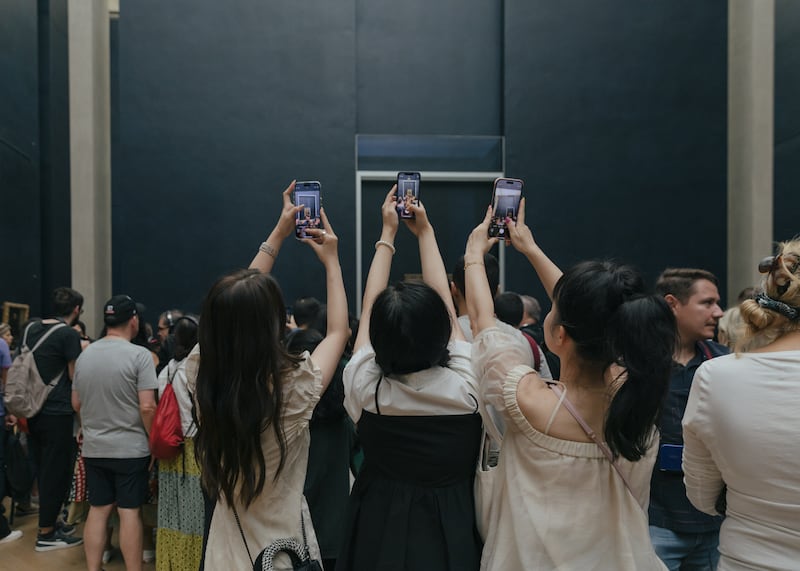
“The problem of visitors coming to museums to make memes or take selfies for social media is rampant,” Uffizi director Simone Verdi said after the incident.
In another case last year in the Palazzo Maffei in Verona, the artwork known as Van Gogh’s Chair by the artist Nicola Bolla collapsed when a tourist put his weight on it while posing for a photo.
Museum director Vanessa Carlton said the two visitors involved had waited for supervising staff to leave the room before staging the photograph and had fled after damaging the artwork. “It would be laughable if it hadn’t actually happened,” she said, making an appeal for respect for art.
In Madrid in 2022, the victim was part of a stage set designed for a performance of a ballet by Alberto Sánchez at the Reina Sofia museum, damaged when a visitor taking a selfie stumbled into it.
Galleries everywhere remain haunted by 2017 CCTV footage showing a woman in a Los Angeles gallery crouching down, apparently to get the best angle for a selfie with some artworks.
She leans into a display plinth, toppling it and causing a domino effect of collapsing display cases that took down 12 sculptures and inflicted an estimated $200,000 in damage.
People want to physically say they’ve been in the same room as it, take a picture and go
— Robert Read, head of art and private clients at Hiscox
Insurance companies have adapted their advice to clients to account for the phenomenon, recommending that any installation or work of art that is likely to be a “selfie magnet” should have extra staff keeping watch.
Other adaptations include security barriers, glass screens, caps on visitor numbers – and bans on selfie sticks, which are deemed a particular risk.
“It’s a strange human characteristic, but as soon as someone has a camera or a selfie-stick, it’s as though they’re oblivious of the time space continuum,” Read says.
“When people are taking selfies, they tend to back into works, or they trip over the barrier in front of the work. They are divorced from normal social interaction in a way that for museums and galleries can be really awkward.”
Not everyone views the practice of taking photographs and selfies as straightforwardly negative, however.
“I don’t think someone taking a quick selfie in front of a painting is any more disruptive than say a school group occupying a gallery for a 10-minute learning exercise,” said Hannah Williams, reader in the history of art at Queen Mary University of London.
Photos and selfies could be a way for museums to reach new audiences and bridge gaps between historical art and contemporary digital culture, she says.
“A selfie might not be intended for sharing but as a memento of an experience, something to keep from the visit, much like a postcard or other item from the gift shop. As we have become so much more digital than material when it comes to memory-keeping more generally, why shouldn’t that extend to museum visiting?”
There is a circular relationship between selfies and over-tourism, according to Lauren Siegel, senior lecturer in tourism and events management at the University of Greenwich.
She has studied the phenomenon of purpose-built “selfie parks”, developed by overburdened tourist sites like Bali as a solution to problematic selfie-taking in the wild.
“Social media creates a situation where people want to travel to the idealised locations or ‘Instagrammable’ places they’ve seen,” Siegel says.
Once there, visitors seek to “recreate the same type of imagery to then share with their own social media connections, further perpetuating the cycle.”

The experience of visiting Leonardo da Vinci’s Mona Lisa at the Louvre has become emblematic of the issue.
The world’s most famous painting is dwarfed by the crowds that gather in front of it each day, often ignoring other famous paintings by great masters that hang nearby.
It is difficult to catch a clear sight of the enigmatic smile, or concentrate among the forest of arms holding up phones and the jostling as people try to angle themselves into photographs with the work.
“It’s behind plated glass, the crowd will be 20 thick in front of you. You’d have much more fun looking at a really good quality digital image, because you’re not going to get anywhere near it,” Read says.
“But people want to physically say they’ve been in the same room as it, take a picture and go.”
Louvre management acknowledged the shortcomings of the experience in 2024 after a mass analysis of online reviews branded the Mona Lisa the “world’s most disappointing masterpiece”. The museum announced plans for a renovation that would relocate the painting to a new, dedicated wing.
This would create a dedicated entry and exit for visitors who only want to see the Mona Lisa – something that could help ease overcrowding elsewhere in the museum and reduce the long lines that form each day at its current entrance.
Yet with an estimated price tag of over €1 billion, the plan has become a subject of controversy, particularly among unions who warn it will worsen conditions for staff.
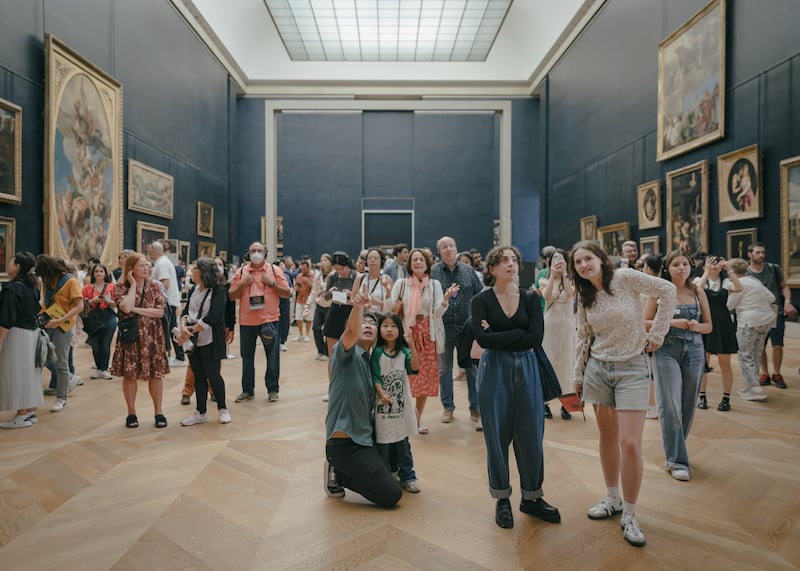
A recent French parliamentary inquiry into safety and security after a high-profile theft of jewels from the Louvre warned any plan to further increase visitor numbers would be “incomprehensible ... given the impact of overcrowding on the building, but also on the working conditions of the staff”.
“The overcrowding caused by mass tourism clearly endangers heritage sites,” the inquiry’s report found.
The issue highlights how the dual roles of museums – to preserve artworks and heritage and also make them as accessible as possible to the public – can conflict.
Publicly displayed works are gradually damaged by the humidity, heat and dust that visitors bring, which adds an estimated additional year of ageing to artworks every seven years.
“The moment you increase the number of visitor groups, you dramatically increase the threat ... the visitor is, in themselves, a threat,” former French culture minister Roselyne Bachelot told the inquiry.
“To best preserve the artworks, they would need to be placed in storage, at a constant temperature and in complete darkness – which amounts to closing the museums,” professor of museum studies François Mairesse said.
As closing the museums is obviously not an option, the question is where to compromise.
The number of visitors annually to museums in France and Italy surged when travel returned in the wake of Covid-19 to reach all-time record levels in 2023 and 2024, part of a broader boom in tourism that surpassed anything seen before the pandemic.
The Louvre accounts for nearly one in 10 of all visits to museums in France, with 8.7 million visitors in 2024. It’s a far greater number than was envisaged when it added its famous glass pyramid in 1989, when the aim was to welcome 4.5 million.
Warnings about the impact go back a decade. An official report on the impact of visitors on the Palace of Versailles, Musée d’Orsay and the Louvre warned in 2015 that they “already suffer from overcrowding that is detrimental to the preservation of heritage”.
Part of the challenge is that such museums were not purpose-built: they are old palaces that were seized from the aristocracy during the French Revolution and converted into public amenities.
“These palaces, jewels of French heritage, were not designed to receive such masses of visitors, and the exceptional works and decorations they present to the public are already suffering,” the report found.
Some museums are deciding that enough is enough. When Madrid’s Prado museum hit a record number of visitors of 3.5 million last year, its director Miguel Falomir announced the museum “doesn’t need a single visitor more”.
The museum already banned photos outright several years ago.
Visiting a museum “can’t be like catching the Metro at rush-hour” Falomir told the media. “A museum’s success can collapse it.”


