
I had 24 hours to kill after a political event in Aberdeen and before meetings I had planned in Fife, so I hid out in the east of Scotland on the Tayside in Dundee. There I found a city riddled with contradictions, at once handsome and ugly, funny and sad.
It really is a funny place. Dundonians are known for their deadpan wit while their city is also renowned as the comic capital of Britain. Dundee is home to DC Thomson, publisher of the Dandy, which ceased in 2013, and the Beano, still going after 88 years. This year the city also celebrates one of its most famous sons: Dennis the Menace is 75.
Like many men now blundering into the thickets of middle age, I was raised on comic strips such as the Bash Street Kids, the Beano characters who were originally based on children from the High School of Dundee, which was near DC Thomson’s old offices.
I had heard that Dundee’s city council had, years before, renamed a city thoroughfare as Bash Street in the strip’s honour. I found it just off Marketgait, in an old industrial area to the west of the grimy, run-down commercial centre. The city gave me my first smile.
READ MORE


The councillors had supposedly chosen that specific location for the tribute because it was also the site of a planned children’s soft play centre. They envisioned real-life kids having fun directly beneath a Bash Street sign. The play centre fell through. These days, tiny Bash Street’s only real feature is the not-very-kid-friendly smoking area of a casino.
I walked through Albert Square, with its locally-famous bronze figure of cartoon character Oor Wullie. He sits near another famous Dundee statue: Scotland’s national bard, Robert Burns. In the grand, facetious Scottish tradition of revellers adorning statues, someone had tried to crown him with a traffic cone, but got his quill instead.
There were more Beano and Dandy cartoon-themed bronze statues on High Street: including an eight-foot Desperate Dan and a catapult-wielding Minnie the Minx.

But it wasn’t all smiles in the city centre. Dundee is acknowledged to have the worst drug problems of almost any city in Europe – only Glasgow has recently overtaken it. Ample human evidence of the city’s chronic polydrugs crisis shuffled about the streets.
While the centre is woefully neglected, planners in Dundee, which is long past its textiles industrial heyday, have encouraged development on the waterfront.
It includes a stunning offshoot of London’s design palace, the V&A (Victoria and Albert museum) at one end. At the other is the HMS Unicorn, a preserved 1842 frigate that is one of the oldest surviving wooden ships in the world.
Dundee’s other big landmark is the Tay Road Bridge that spans the Firth of Tay, whose calm estuary waters shimmered all weekend in the late autumn brightness – Dundee is also the sunniest city in Scotland.
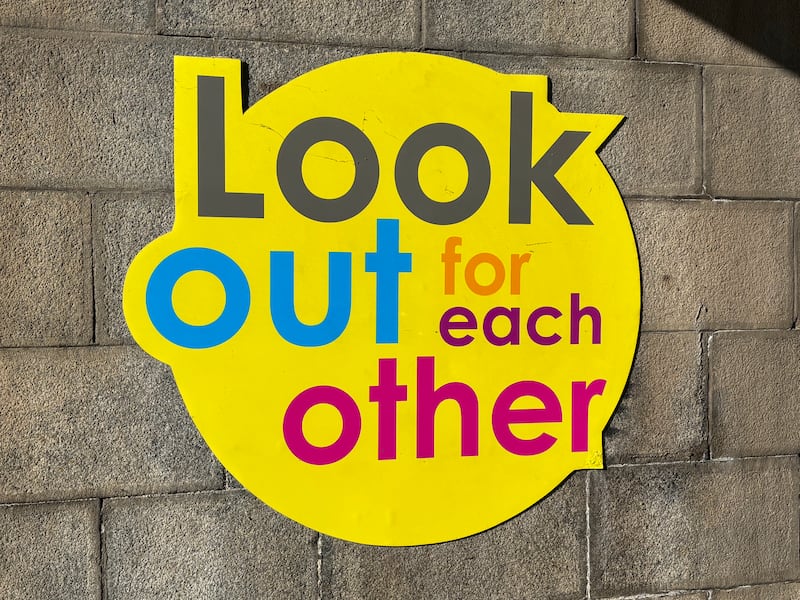
As I walked along the waterfront past the point where the bridge reaches out across the Tay, I noticed a large, colourful sign on the wall: “Look out for each other.” The slogan was repeated in the pedestrian lift up to the bridge and various points thereafter.
Ostensibly, it seemed to allude to the need for cyclists and pedestrians to be careful as they shared the path across the bridge. But it could also have had another connotation: bridges the world over spell danger for the most desperate of people. In Dundee too.

Scottish government data indicate Dundee has the highest suicide rate of any Scottish city. Local charities blame the city’s drugs crisis, the ingrained deprivation wrought by decades of Dundee’s industrial decline, and over-strained mental health services.
Police Scotland has a grim official categorisation for call-outs dealing with people who are spotted in situations where they are in danger of acting in such a desperate way. They call them “concern for person” incidents. The Tay Road Bridge is a hotspot.
After a number of high-profile, tragic cases this year, there is an ongoing local campaign to get bigger safety barriers installed on the Tay Road Bridge. Meanwhile, the people of Dundee continue to look out for each other. Local mental health charities and volunteer groups have recently galvanised to collaborate in a “suicide prevention collective”.
That night, I returned to the city centre to find that Dundee’s myriad social problems had multiplied in the dark. Parts of the city centre are quite handsome in the daylight, but there is a far grittier edge to the place at night. This is acknowledged among Dundonians.
[ Two sides to the story in city dubbed ‘Yes capital of Scotland’Opens in new window ]
Yet the city also retains its indomitable free spirit. Dundee is widely considered to be the ‘Yes’ capital of Scotland’s independence movement. While the nation as a whole voted 55 per cent ‘No’ to 45 per cent ‘Yes’ in the 2014 independence referendum, Dundee returned a 57.4 per cent ‘Yes’ result, the highest of any region.
It is a city embroiled in a difficult transition from its past, still at the heart of the debate about Scotland’s future.