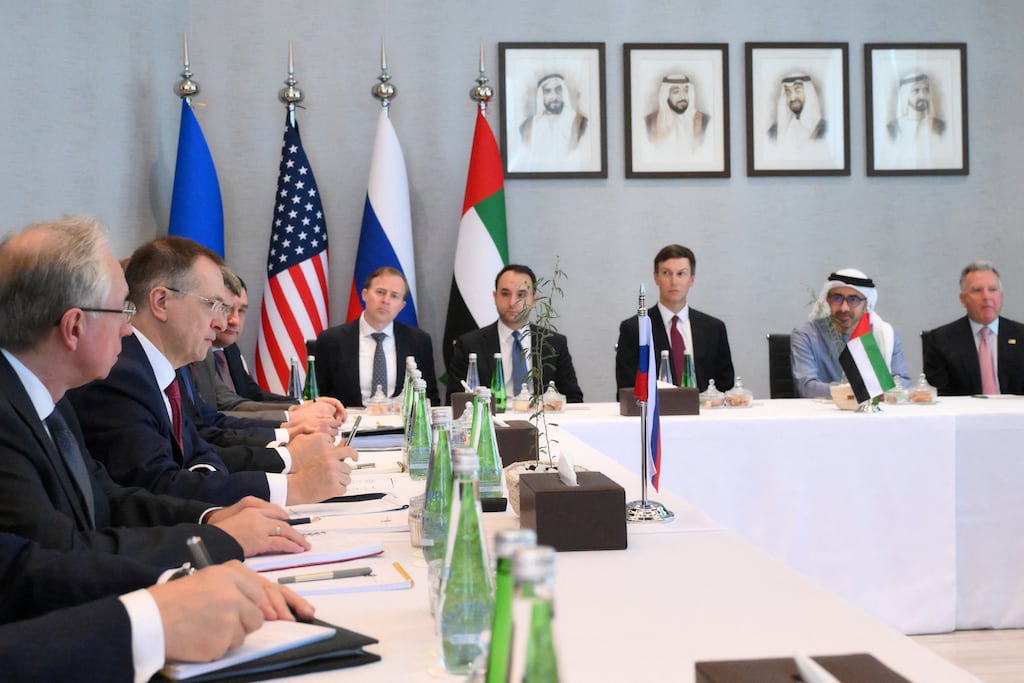
Negotiators from the US, Ukraine and Russia have met in Abu Dhabi for their first trilateral talks since February, reviving a diplomatic effort to end the war that stalled after US president Donald Trump launched his military campaign against Iran.
A first day of talks concluded on Tuesday, set to be followed by further talks on Wednesday centred on postwar security arrangements for Russia and Ukraine and issues of territory in eastern Ukraine, US officials said. Washington saw resolving both sets of issues in tandem as crucial to ending the war, they added.
The discussions build on a flurry of diplomatic contacts last month, with US officials saying they are now in daily contact with the Russians and Ukrainians.
Speaking in Paris after the G7 foreign ministers’ meeting, US secretary of state Marco Rubio said the talks “went very well”.
READ MORE


But expectations of a breakthrough remain low, with Russian president Vladimir Putin showing little sign of a willingness to end the conflict, now in its fifth year.
A US official said the Trump administration was seeking to get Russia to agree to multilateral talks involving European officials. “We do believe very strongly that at this point, in order to end the war, you really need to have Europe at the table,” they added.
Russian foreign minister Sergey Lavrov, who did not take part in the talks himself, said on Tuesday that Moscow would not let European countries take part directly in the talks, even though several of them sent officials to Abu Dhabi, and accused them of simply trying to buy time for Ukraine.
“They flew to Abu Dhabi. Let them sit in the hotel,” he said.
He added that Moscow also would not agree to Ukraine’s push for a limited ceasefire. “We won’t agree to yet another ceasefire without any understanding of what happens next,” he said.
Lavrov said Russia would only start discussing a peace settlement after “clear outlines of a future security architecture” were agreed.
Ukrainian president Volodymyr Zelenskiy said on Tuesday that he had been briefed by his negotiating team on the first day of talks, which he described as “constructive and quite substantive”.
“They spoke in detail about the substance of security guarantees for Ukraine and the foundations for ensuring these guarantees function over the long term ... The need for de-escalation steps was also touched upon,” added Zelenskiy.
The Trump administration’s suggestion last week of a new European security “framework” negotiated with Moscow alarmed European capitals, which insisted they must be involved in any such talks and that a settlement in Ukraine must come first.
US, Ukrainian and European representatives held “collaborative” talks on Tuesday that focused on “a practical and mutually reinforcing security framework that strengthens Ukraine’s long-term security and builds the confidence necessary to reach a negotiated settlement”, the European Commission said in a statement.
The discussions, which took place in advance of the US-Ukrainian-Russian talks, also “covered how to build upon existing European security institutions and agreements following the conclusion of the war in Ukraine”, it added. British, French, German, Italian, and EU and Nato representatives did not meet the Russian delegation, however.
Trump’s special envoy Steve Witkoff wrote on X that the talks with the Europeans “took place collaboratively” and included “how to build upon existing European security institutions and agreements following the conclusion of the war in Ukraine”.
“The participants reaffirmed their shared commitment to a strong postwar European security architecture and arrangements, and were clear that a strong Nato will remain central to Euro-Atlantic collective defence,” Witkoff added.
The US president said last week he hoped talks with Russia would produce “a big, beautiful deal” extending far beyond Ukraine.
The US official said the administration had asked Moscow if it would object to Washington providing Ukraine with an “Article 5-like” security guarantee, referring to Nato’s collective defence clause, and for the alliance to offer the same.
Any final decision on the nature of a US security guarantee would ultimately be up to Trump, they added.
Russia has said it welcomes the shift to discussing future postwar security guarantees but has otherwise shown no indication Putin is prepared to make concessions.
Russia’s president sees this winter as an ideal juncture to weaken Ukraine through a devastating campaign of air strikes on its infrastructure, according to people briefed on his thinking.
He has demanded Ukrainian forces withdraw from areas of the frontline Donbas region under Kyiv’s control as a precondition for a ceasefire and would link any future security guarantees to more territorial concessions, they said.
Zelenskiy, for his part, has said that any talks on territory could only be held in a meeting between leaders. – Copyright The Financial Times Limited 2026