No career is linear but Tom Farrell has had more deviations than most. First, he kept afloat after being released by Leinster with a spell in the English Championship, before pulling himself up again with Connacht and then, when released by them, with Munster. And now, finally, at 32, comes Farrell the fully fledged, twice-capped Test player.
His autumn was full of surprises, to say the least. He initially missed out on the Irish 36-man squad and, having not been picked for the summer Tests against Georgia and Lisbon despite his impressive 29-game body of work last season, Farrell had finally given up on his dream of ever playing for Ireland.
But then his first performance of the season, in Munster’s 31-14 win over Leinster at Croke Park, prompted a late call-up to the Irish squad for the Autumn Nations Series and a Test debut against Japan.
That might have been that until injuries to Stuart McCloskey and Robbie Henshaw opened the door to a place on the bench against the Springboks and a 16-minute second cap in that wild 24-13 defeat.
READ MORE


“It was mad all right,” he says. “Was it five cards? Yeah, it was a mental game to be involved in. I don’t think we’ll see anything like that again.”
It’s hard not to believe that his first month of exposure to the Irish squad and international rugby will have made him a better player, or at least a more confident one, but he’s scarcely had time to reflect.
“It’s just so relentless, just next thing and move on. It’ll probably be the end of the season, or if I get a week off during the year, when I can probably have a reflection and enjoy it for what it was. But at the moment I don’t really have time.”
Yet, while he hasn’t fully taken stock, it was memorable.
“Just to be involved in that calibre of game, that calibre of player, the whole event, the spectacle, everything, they’re the games you dream of playing.”
What’s more, Farrell is grateful to have quickly earned more than one cap.

“It’s a weird one. I was itching and buzzing to get in but then the second, you’re in the goalposts move so quickly. ‘Okay, now I want to get selected for a game. Now I want to get a cap. Now I want to add to that one cap, I want to keep getting more and more’.
“A couple of months ago, I would have been desperate just to get into the squad but when you do get a taste for it, you want that bit more. Then, as soon as the campaign is over, it’s literally just flick the page and you’re on to the club scene, which is what I’ve been used to for the majority of my career, so it’s no real difference.”
That may well be so, but the Champions Cup games are Test shop windows, especially as Farrell and Munster face Bath, the best side in England and one stacked with good midfielders.
“They can roll out two different forward packs and they are just as good as the other, and their back line as well. They have that ability to play in tight and rumble through the middle, but then they have a full international back line as well to go with it. So, it’s the full array.”
Farrell actually made his Connacht debut in the Champions Cup, at home to Zebre eight seasons ago, and there were seven more appearances in that competition with the western province, including away to Toulouse, Leinster, Stade Français and Saracens.
But Munster in the Champions Cup has a unique cachet, as he discovered last season with that epic Round of 16 win in La Rochelle.
“When I was at Connacht, just from the outside looking in, Munster was always associated with Europe, and that La Rochelle game in particular, just to see the travelling support that day, it really just hit home how big the competition means to Munster. That was the one that opened my eyes to it.
“I presume this weekend will be similar with supporters, as much as it can be, because Bath’s quite accessible to get to between Bristol airport and down from London, so I think there’s a shout of a good few Munster fans coming over.
“I don’t know if they’ll all have tickets but they’ll be there or thereabouts anyway!”
It’s hard to quantify this.
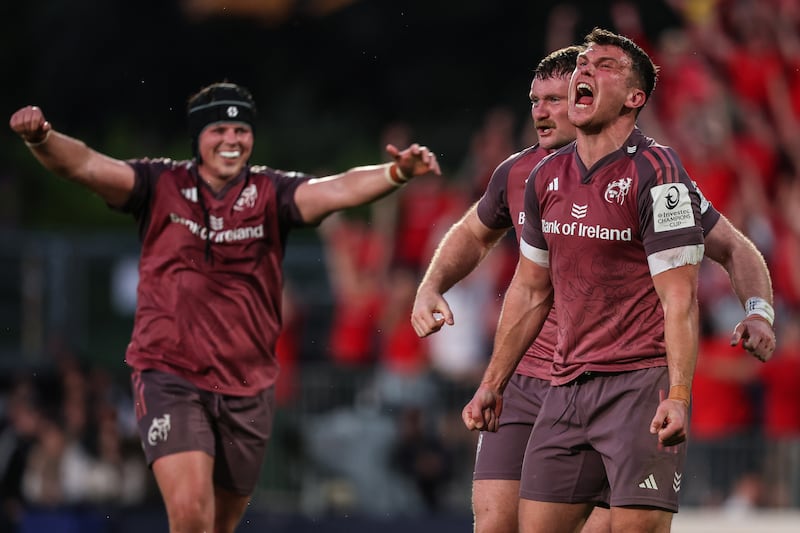
“It lifts you another 10 or 15 per cent knowing that you have that support behind you. I have videos on my phone of that game, just some of the support. It was crazy looking back on it.”
And those past forays to various corners of England and France, whether in the past or more recently, also fuel belief that they can reproduce such performances.
As he returns to England this weekend, it seems apt to reflect on the Championship being where he first rebuilt his career. A product of Castleknock College and Lansdowne, Farrell was released toward the end of his three-year stint in the Leinster Academy when he sought pastures new, with London Irish briefly and then for a 12-game stint with Bedford in the 2016-17 season.
“It just gave me regular game time, which is so important. Exposure to a decent level, not the top level obviously, but I knew going over there that a lot of Premiership clubs are connected with them. Bedford would be quite close to Northampton, Nottingham would be with Leicester, Exeter with Cornish Pirates.
“There’s a lot of connections. So, I knew that Premiership clubs always have eyes on the teams. It just gave me regular game time, which was so important at that age. It was good fun. I was 21-22.”
Keeping his name on the Irish radar, however remote, worked too.
Connacht had a midfield injury crisis, with Craig Ronaldson, Peter Robb and Rory Parata (an Australian born product of the province’s academy who is now with the Cornish Pirates) all sidelined.
“It was a case of right time, right place,” says Farrell. “I never had an offer from the Premiership. To come back to Ireland was the number one goal and I got lucky.” Farrell smiles and adds: “Very lucky.”
As well as Parata, there’s a host of good players plying their trade in the Championship, including Rory Scannell, who is at Ealing Trailfinders.

The standard?
“The top teams would be at the bottom end of the URC, the likes of Ealing Trailfinders.”
While the general style was not that expansive, Farrell was also fortunate that Bedford threw the ball around. Among his team-mates were Matt Gallagher, now at Benetton, and Tom James, sub scrumhalf at the Saints.
Bedford were also well supported, and his favourite game of the dozen he played was in front of a bumper 2016 “Boxing Day” crowd of nearly 5,000 for a home game against Jersey, which Bedford won 39-37.
“My last game, my swansong. A last-minute winning try. It was a nice way to sign off. A bottle of champagne to celebrate it. That’s what they used to give over there to the man of the match.”
Letting slip a 21-6 interval lead in losing at home to the Stormers last Saturday doesn’t look like the best preparation for a Champions Cup tie away to the best side in England.
Yet the players conducted reviews of that defeat in mini groups and concluded that that “little blip” didn’t change what they set out to do.
“There was lots of good parts in that Stormers game that we were actually happy with; a lot of metrics in the game, a lot of key figures and stats and things that we were happy with, and we just probably lost our way a bit in that last 30 minutes. It doesn’t change a whole lot to be honest.”
Farrell rewatched Bath’s 36-29 win away to Saracens last weekend and noted that Johann van Graan even rested some frontliners who would return to face Munster. He has a pretty good idea of what will be required.
“Just a complete performance. We can’t really rely on one aspect of our game. It probably won’t be enough. We’re going to need every aspect of our game – our attack, our defence, our set-piece, everything – firing. Because if one of them is missing it probably won’t be enough going over there.”