
I may not be alone in this, but my personal reference point for a year is the All-Ireland championship. Even for otherwise consequential years, that is what is occurs to me.
In 1978, I did my Leaving Certificate and went to college but when the year flashes up, the scene that flickers in the mind is Dublin, unstoppable in the decade’s persistent drizzle, moving 0-6 to 0-1 ahead by the 25th minute of that year’s final against Kerry – after which they scored just three further points and conceded 5-10.
As we approach the winter solstice, 2025 is fading like the light and it will shortly be time to reflect on what happened this year and to categorise what of its events will stay with us into the future.
The All-Ireland finals this year were interesting affairs. Any year that returns Tipperary and Kerry as champions might feel like it needs to be more specific. However, strangely for counties that have a combined 68 titles, they haven’t won them in the same year since 1962 – and on just two other occasions, 1937 and 1930.
READ MORE


There is an argument to be made that this GAA year may be better remembered for what happened off the field – the new rules in football and two potentially landmark reports, from the amateur status and demographics committees – but the games had strong years.
Both All-Irelands were testament to teams timing their runs to perfection. Kerry had laboured to the point of dismissal, including sustaining a thrashing from Meath. But once back in Croke Park and pitted against defending All-Ireland champions from Ulster, Jack O’Connor’s team soared.
That quarter-of-an-hour that saw an unanswered 0-14 whistling over the Armagh bar sent the champions packing and restored Kerry’s sense of wellbeing.
How often has that catharsis been played out in Croke Park? Kerry, apparently cracking under the pressure of injuries and poor form, arrive in town and confound the negativity. Seán O’Shea underlined his status as the team’s “spiritual leader” – as O’Connor termed him – with 0-12, but the season’s risorgimento was led by David Clifford.
From the urging of supporters to get behind the team, to his Croke Park performances – symbolised by the Zen appreciation in first-half overtime of when to stop leading Brendan McCole a slow foxtrot out along the sideline and when to cut in and kick the killer two-pointer.
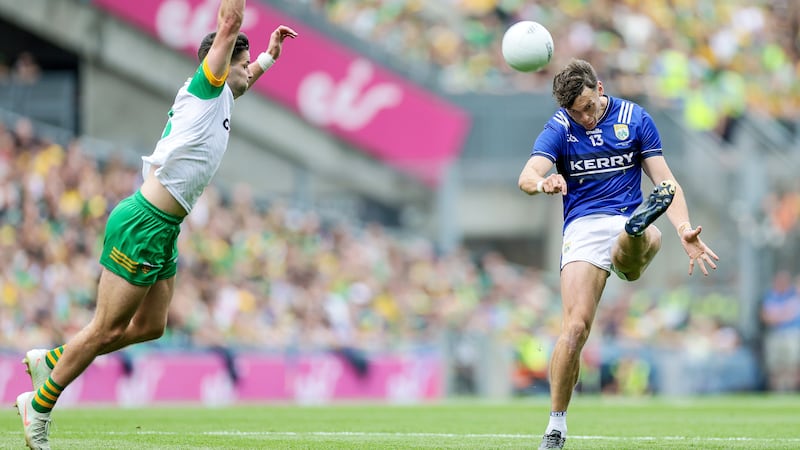
Donegal were left processing a seven-point deficit when a five-point gap would have been oddly cheering.
Clifford, still only 26, is now just one Footballer of the Year award behind Jack O’Shea’s four. If the books haven’t been closed on that eventuality, they probably should be.
Then again, it may be futile trying to disentangle the new rules from the year’s champions. Even in the above paragraphs, O’Shea’s dozen featured three two-pointers and Clifford’s All-Ireland score was choreographed according to the FRC’s protocol on time keeping (since amended).
Donegal’s inert response, hanging back and not challenging possession, felt old-school and was punished by the two-pointer.
In a sober piece of post-hoc rationalisation – having believed Donegal would win the final – this column reflected: “It is easy to understand how a new set of playing rules, intended to declutter forward play and reward long-range shooting, benefited the team with the greater number of outstanding individuals.”
Twenty-twenty vision.
The success of the new rules led to more exciting matches all summer – until, crucially, the Croke Park rounds when there was hardly a competitive fixture to be seen. Whether the two things are connected – it’s hard to imagine how they might be – will become clearer next year.
A landmark event was the end of the road for Dublin. Dessie Farrell stepped down after six seasons and two All-Irelands and the county lost Leinster for the first time in 15 years.
Louth took advantage with a first provincial title in 68 years – a remarkable achievement for the county and its manager, Ger Brennan. To put it in context, Leitrim’s great triumph in 1994 was a first Connacht in 67 years. Brennan is now home, hoping to orchestrate Dublin’s next generation into a revived challenge.
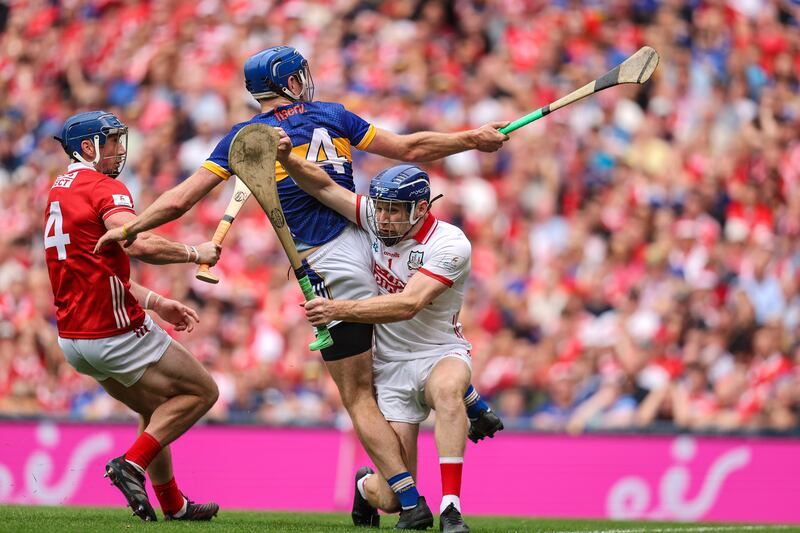
Hurling didn’t have the engine of rewritten rules to drive on the season, but largely didn’t need it, apart from in respect of discipline. Football became obviously the better-behaved game. The solo-and-go allowed it to flow, eliminating flashpoints, as defenders scrambled to defend and keep up with the play.
The dissent and delaying penalties have – for all the controversy of the conclusion to Sunday’s epic Munster club final – been tabled for introduction into hurling.
Tipperary’s All-Ireland came with epic reinvention after two wallopings from Cork in springtime’s league final and Munster round-robin fixture. Perhaps it is more accurate to say fast-moving evolution over reinvention.
This wasn’t a traditional reset like the one the county benefited from in 2019. Back then, following a hammering by Limerick, they bounced back, watched as their tormentors got beaten by Kilkenny and seized the day. This year was more a steady development that surmounted, one by one, serial obstacles and went on to beat the team that had annihilated them just three months previously.
Once Liam Cahill had absorbed the Páirc Uí Chaoimh lessons, his team improved match after match. A tricky match in Ennis had to be effectively won twice before wins over Waterford, Laois, Galway and Kilkenny propelled them into the final and a fourth competitive outing against Cork.
This steady improvement contrasted with Cork’s staccato progress after a dominant league, through a patchy Munster campaign, which nonetheless culminated in a provincial title win on penalties. This was followed by a bloodless semi-final against Dublin, whose sensational defeat of Limerick appeared to have the same effect on them as a bee delivering its one sting.
The final may have been an inexplicably traumatic outcome for Cork, but their opponents were ready.
Tipp were driven by John McGrath’s return to best form and the leadership of Ronan Maher and Jake Morris. But the presence of under-20s Darragh McCarthy, Sam O’Farrell and Robert Doyle gave fresh impetus and there are more where they came from for next year.
Until then.