

Irish-headquartered technology company Equal1 is on a mission to democratise quantum computing and make the transformative technology accessible and affordable. The company has developed Bell-1, the world’s first rack-mounted silicon quantum computer designed for high-performance computing (HPC) data centres.
Until now, quantum computing has largely been confined to research institutions. Equal1 is changing that paradigm. The same size as a standard desktop server, Bell-1 comes at a fraction of the cost of existing quantum computers and plugs into a standard electrical power socket and consumes just 1,600W during operation – significantly less than traditional quantum systems.
The importance of this breakthrough technology cannot be overstated. Classical computing may appear fast, but quantum computers can solve specific, highly complex problems exponentially faster. Certain tasks such as complex cryptography can be reduced to minutes instead of years.
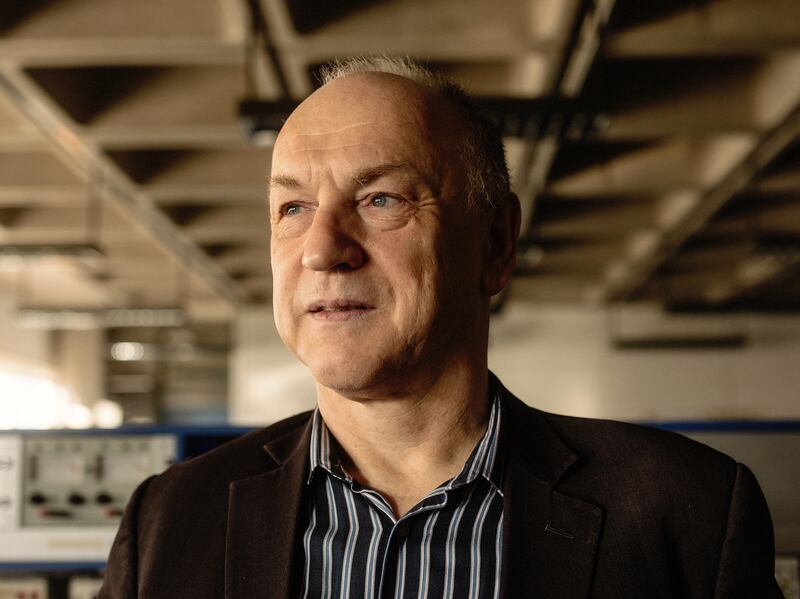
Equal1 co-founder Prof Bogdan Staszewski explains that classical computing based on bits – ones and zeros – has enabled the creation of extremely complicated and powerful algorithms but it has its limitations, including the vast amount of energy consumed by applications such as artificial intelligence (AI) and machine learning.
READ MORE


“To go forward we need to go beyond the rules of classical computing and the only thing that can do that is quantum computing,” says Staszewski. “Quantum computing is fundamentally different. It is based on randomness. Randomness is at its core.”
How it works and achieves those astonishing speeds is something of a mystery. Staszewski uses the analogy of the human brain. “We don’t know how it works. It only uses 20W of power and can do processing that would require hundreds of gigawatts of power for computers to do. Some scientists speculate that the brain is a quantum computer.”
The physics of quantum computing can defy human comprehension. Something called quantum superposition allows particles to exist in multiple states simultaneously while entanglement links particles in a way that their states remain instantly correlated regardless of distance. In essence, these allow a particle to exist in two places at the same time or two particles to be connected across vast distances in such a way that when something happens to one it also happens to the other. That’s a very simple and crude way of putting it.
The possibilities it opens up are easier to understand. “Quantum computing can allow us to create new materials and new drugs,” he explains. “If a new pandemic occurred, a quantum computer could spit out a blueprint for a drug for it within minutes.”
The Equal1 story and its location in Ireland goes back to 2014, when a research professorship funding award from Science Foundation Ireland (now Research Ireland) brought Staszewski from Delft University of Technology in the Netherlands to University College Dublin in 2014. His goal was to establish an expert research team working on mixed-signal and millimetre-wave integrated-circuit design for emerging applications, such as 5G, radars and quantum computing.
He cofounded Equal1 in California in 2017 with colleagues he had previously worked with in Texas Instruments. They had worked on mobile phone technology together and then had the idea of putting quantum computing into every mobile phone using quantum dots, tiny semiconductor crystals just a few nanometres in size. Moving on from there, Equal1 was established to use silicon complementary metal-oxide-semiconductor (CMOS) quantum dots to build quantum computers from the ground up.
Interestingly, the company encountered difficulty in raising funds there. “The funding we were offered would have meant we lost control of the company,” he says. “We would have been glorified employees.”
That’s where his links with Ireland came in and the company secured investments from Dublin-based international deep tech venture capital fund Atlantic Bridge and Enterprise Ireland. Equal1 relocated to NexusUCD in Dublin and now has design centres in Dublin, California, Romania, the Netherlands and Canada.
“At present we have a working model prototype of a quantum computer. It’s small but can be used to run experiments. The problem is the complete opposite to mainframe computing many years ago. Back then you had very few programmers for those computers. Now we have lots of quantum programmers but very little hardware. Using the Bell-1 they can run programmes on real hardware.”
The company has raised $85 million to date, including $60 million in the latest funding round from the Irish Strategic Investment Fund, Atlantic Bridge Ventures, European Innovation Council Fund, Matterwave Ventures, Enterprise Ireland, Elkstone and TNO Ventures.
The new funding will be used to bring the prototype into production. “We will be offering quantum computing at one tenth of the price of current models and we think they will sell like hot cakes. Hopefully, we will become self-funding after that.”
The new funding will also be used to increase the capacity of the Bell-1. Its capacity is measured in qubits, the quantum equivalent of classical computing bits. It is currently six qubits, and the company aims to increase that to millions by the mid-2030s.
It also intends to ramp up employment. “We have 50 full-time employees at present and plan to hire 60 new people. Fundraising will continue. In a start-up such as ours, there is no such thing as enough money.”


