Artificial intelligence (AI) related products are making a significant contribution to the Republic’s export performance, accounting for nearly 13 per cent of all goods exports so far in 2026 compared with just 6 per cent in 2025. This is not the only role the technology is playing, however.
Irish exporters are increasingly leveragingAI and innovation to gain an edge in intensely competitive overseas markets. A survey carried out by Enterprise Ireland in 2025 found that almost nine in 10 (87 per cent) of businesses are already integrating or planning to integrate AI into their business operations, with two-thirds believing AI and digitalisation will be critical in winning future international business.
Experts say AI is being cleverly and strategically deployed by Irish firms for tasks such as scanning export market data, supporting customs and regulatory compliance, logistics planning and optimisation, demand and inventory forecasting, and marketing collateral localisation.
Mark Kelly is founder of AI Ireland. He says the organisation is seeing AI used by Irish businesses to support planning, compliance, forecasting, operational decision making and access to business information.
READ MORE


“For example, Oac Snacks has developed a multi-agent planning system to support commercial, supply and finance decisions, with human approval retained, while Adherent is using agentic AI for product compliance, translating regulations into actionable requirements and cited recommendations,” says Kelly. “Meanwhile, YieldHUB is using AI agents in semiconductor manufacturing to support decisions around yield, retesting and production capacity.”
The biggest gain, Kelly says, is often reducing manual searching, checking, reconciling and moving information between systems. “AI can bring relevant information together faster, allowing people to spend more time on judgment, exceptions and higher-value decisions.”
This is crucial, he says, because for Irish companies competing internationally, speed and responsiveness matter.
“AI can help smaller teams analyse information faster, prepare quotations more quickly, improve planning and respond to changing customer or regulatory requirements,” he explains. The advantage is not simply having access to AI as, increasingly, many companies have similar tools. “The real advantage comes from how well a business connects AI to its own processes, people and proprietary information.”
Terence McGivern is chief operations officer with Clad Pad, which manufactures cladding protection systems. Despite just entering its third year of business, it now operates in 15 countries across three continents “with a very small team”, notes McGivern.
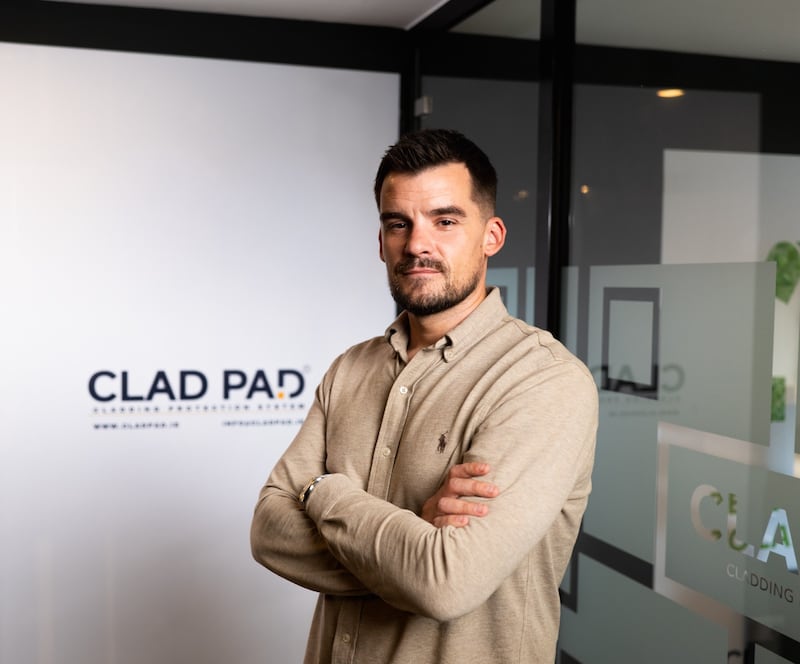
“Clad Pad is a new company, and we created our own category,” he says. “Before November 2024, a reusable magnetic cladding protection system didn’t exist. When you’re inventing a category, there’s no playbook and no legacy habits to protect, so we questioned every part of the business from first principles and built it around AI from day one.”
For example, AI capabilities mean Clad Pad as a business looks markedly different from how it would if it had been launched even a decade ago. “We’re lucky with the timing,” admits McGivern. “A few years ago, a business at this scale would have needed far more people. Today AI lets us build a lean, resilient team despite our international presence.”
Clad Pad has built its system architecture around a small number of well-known large language models that the team believe will serve them long term, says McGivern. “Because we documented our processes and policies up front, our AI knows how Clad Pad works, so routine work like quoting, multilingual documentation, pipeline tracking and admin is handled by workflows and agents rather than extra people.”
Soon, a client portal will give customers live views of their orders and logistics, along with data and insights that support their own goals, such as ESG and carbon footprint reporting. “It’s the same intelligence we use internally, and our clients will see and benefit from it,” says McGivern.
Clad Pad’s challenge overseas is that the industry has used single-use corriboard and plywood for 25 years, and procurement teams have no process for assessing something new. “So, our goal is to win on trust, speed and responsiveness, and we have to prove the category in every new market. AI has taken the admin burden away, which lets us spend our time, building real relationships with installers, contractors and clients. In construction, that is what wins work.”
It also lets Clad Pad respond like a much larger company, McGivern adds. “A contractor in Finland, Germany or UAE gets a quote in their own language, with the right branding, freight and terms, in a fraction of the time. Our systems keep every conversation, order, shipment and container organised across 15 countries, so the follow-up is as sharp in the 10th market as in the first.”
John Whelan, international trade consultant and managing partner of the Linkage Partnership, says it is imperative that Irish exporters embed generative tech and AI into their business if they want to get ahead in international markets.
“Indigenous sectors must deeply integrate artificial intelligence into their core products,” he says. Whelan points out that AI start-ups are commanding the lion’s share of international investment. “For sectors like biopharma and digital health, transitioning to tech-driven, AI-powered solutions are essential to match global scaling velocities.”