

Alcohol consumption in Ireland is in a downward spiral having fallen roughly a third since 2001. According to Drinks Industry Group of Ireland, a lobby group, average alcohol consumption per adult fell by 4.5 per cent last year alone.
At the same time, the industry’s most vibrant sector, its pubs, are at risk of going down the drain. A quarter of Ireland’s pubs closed in the past two decades, with, it cautions, a further 600 to 1,000 set to follow over the coming decade, in the absence of government intervention.
But it’s not all gloom and doom, according to Elliot Hughes, boss of Dingle Distillery and Dublin’s first microbrewery, The Porterhouse..
He experiences first-hand the challenges publicans and drinks makers face right now. He doesn’t find the fall off in alcohol consumption sobering so much as comforting, because it brings us closer to the EU average. But that means the industry is due some slack in the form of a cut in excise duty, he claims, as it remains among the highest in Europe.
READ MORE


“To have one of the largest excise duties in Europe and yet not have one of the biggest consumption rates is kind of punishing Irish people for what was maybe a stereotype,” he argues.
Dingle Distillery makes vodka and gin as well as a range of whiskeys. It recently added a new single pot still as well as a new 10-year-old whiskey to its repertoire.
The additions reflect growing demand, most of which is coming from the USA, despite the difficulties in that market.
“Our US sales volumes are up between 30 and 35 per cent this year over last,” says Hughes.
Absorbing costs
Tariffs haven’t had any impact on sales growth, but only because they’ve had to be absorbed instead by the distillery, its importers and distributors. “Everybody is taking a bit of the pain, but overall, it’s better for us to take it than the customer,” he says.
Perhaps surprisingly, the Irish card doesn’t bring nearly as much luck in overseas sales as we might think, leaving spirits to sell on their merits.
“In Ireland, we think Irish whiskey is a big global product on a par with scotch and bourbon, when the reality is that those two are out on their own. But what there has been in recent years is a massive increase in interest in, for want of a better term, ‘world’ whiskeys, from Japanese to Canadian. Though Irish whiskey has a bigger footprint than lots of others, we’re positioned with those,” says Hughes.
From the start, Dingle Distillery’s vision has been one of growth through exports. “I don’t think anybody can survive as a business in the spirits industry by focusing just on Ireland,” he says.
That said, Ireland still accounts for about 60 per cent of sales by volume, so the home market is important. Here sales have been flatter.
It is wholly possible to achieve growth in a falling market, he says, particularly as consumers here shift to a “drink less, drink better” mindset.
As well as the distillery, Hughes has two pubs in Dublin and one each in London and New York, enabling him to also spot global trends in the trade.
“Pubs need to work a bit harder to bring in customers that maybe aren’t as drawn to going in and having pints on a weekday evening as they were. We’re seeing it all the time now, whether it’s pub quizzes or bingo, all aimed at a younger demographic who want that entertainment piece as well,” he explains.
He points to pubs such as Flight Club, which runs social darts, and the golf pub Pitch, both in Dublin, as good examples.
Board, a non-alcoholic pub in Clanbrassil Street, packed with board games, is perhaps an even more striking example of how the market is changing.
Non alcs come of age
That’s because the fall in alcohol consumption is also giving rise to new business opportunities, such as Fierce Mild, a nonalcoholic beer brand set up by Fergal Carroll and Cathal Byrne in Dundalk.
They came up with the idea, having lived for years in Australia and Canada and seen how the market for nonalcoholic beers had grown in each of these countries.
In each case, it wasn’t a question of breweries simply bringing out a non-alcoholic version of an existing beer, but craft beers specially brewed that way, for enhanced flavour.
The rise in non-alcoholic drinks isn’t about teetotalism so much as about healthier lifestyles, the same impetus that sees younger people flock to saunas as a social outlet, says Carroll.
“We’re not banging the sober movement drum, we’re about flavour, choice, and doing your own thing. You can see the shift. It’s about reducing, about moderation, about picking quality over quantity,” says Carroll.
The fall in alcohol consumption may of course also be about the rise of recreational drug use but, by its illicit nature, that’s harder to quantify.
Whatever the reason, it has affected the country’s approximately 80 independent breweries, about 10 per cent of which have closed since January. There have been some high-profile distillery closures, too, including Killarney Brewing and Distilling Company.
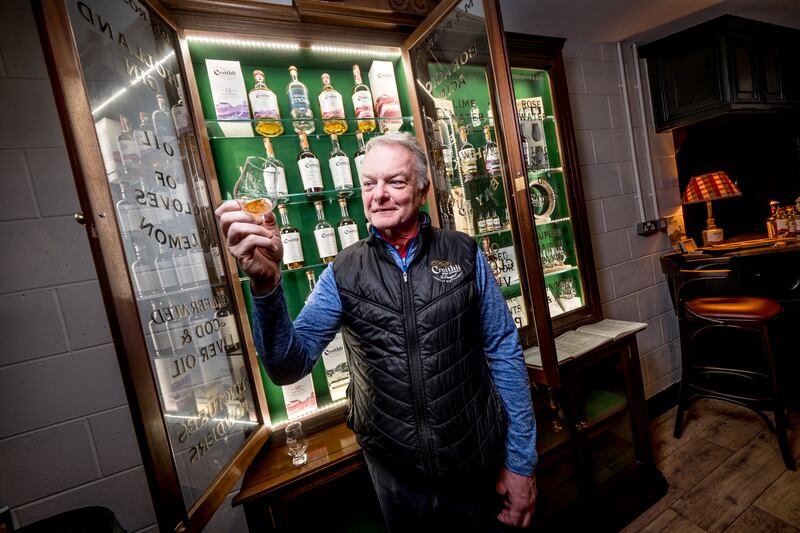
Others, such as Crolly Distillery, set up just five years ago, are growing.
The Donegal distillery and visitor centre, housed in the former world-famous Crolly doll factory, is going from strength to strength, according to co-founder Conor McMenamin.
Today 80 per cent of its Croithlí whiskey sales are made direct to consumers online, but off-trade sales are also growing, particularly in Dublin.
It’s also exporting to Germany, France and the UK. While the plan had been to focus on the US, he’s more circumspect about that now. But it’s steady as she goes at home. “Our sales this year were up double digits”, says McMenamin, happy to be bucking the trend.
Also on a growth path is Valentia Island Vermouth, a premium spirits maker established in 2021 by Kerry couple Orla and Anna Snook O’Carroll.
It won the Most Investible Company award at this year’s AxisBIC Venture Academy, a business accelerator, while the product itself has won gongs from Blas na hÉireann.
Cocktail culture
The pair are raising investment for international growth, supported by Enterprise Ireland. “We’re bringing it to US cities such as New York and DC, to bars with a really strong cocktail culture,” says Orla Snook O’Carroll.
Cocktail culture is growing at home, too, which is why she is unfazed by falling alcohol consumption rates here. Indeed, she recalls one person telling her he didn’t see the guys in his father’s bar ever changing over from their Heinekens or their Guinness. “But we were never going after those lads. We’re going for someone who is interested in premium vermouth. We were always going to be niche,” she explains.
One of the biggest independent success stories in recent years is Mary Sadlier’s Coole Swan, a premium creme liqueur. Here, too, sales are on the rise. “We’re doing very well, growing in Ireland, the UK, Canada and the USA,” says Sadlier.
Domestic sales are up by double digits.
She attributes this first and foremost to the product. “We have a really high-quality liquid and people still appreciate that. Once people start drinking Coole Swan, they don’t go back,” she says.
“We hugely encourage the whole concept of sip and savour. We’re not a drink you’ll rock up to the bar demanding at two o’clock in the morning. We’re sitting in the Westbury Hotel meeting a friend for a drink,” she says.
Sadlier, a chartered accountant who formerly held a senior position with drinks giant Diageo, knows what it takes to succeed.
“We have figured out a model that doesn’t have to chase volume. We’re chasing consumer desires, we’re chasing the consumer’s palate,” she says.
She points to interest in food label specialists such as Sophie Morris as evidence that younger consumers are making much more considered purchases in food and drink, to the benefit of smaller brands.
Unfortunately, the far greater challenge is that just a handful of giants still owns 85 per cent of the world’s alcohol market. “That leaves the rest of us knocking each other out to get the other 15 per cent,” she says.


