A British MP once asked Tony Blair why the then-prime minister had been so successful. “Because I’m not seen as being as left-wing as you lot,” was Blair’s reply. The MP he was talking to was a Conservative.
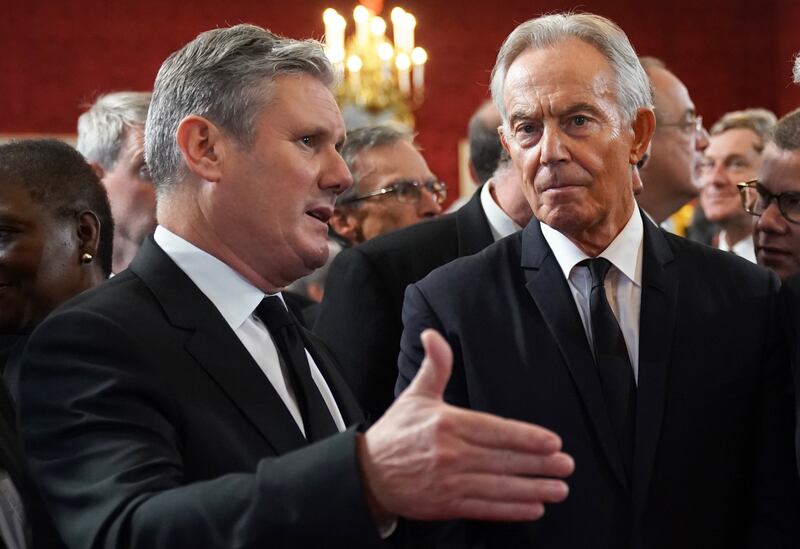
So ran a joke I remember from the 1990s or early 2000s on the satirical panel show Have I Got News For You, which, like Blair himself, is still going after all these years. I was reminded of the gag this past week as the former prime minister published a 5,000-word essay accusing the Labour Party he once led of “playing with fire” by rushing into a leadership contest without what he deems a serious debate on policy.
Any serious analysis of the current world and immediate future has to engage with hard realities that cannot be wished away, Blair argues. These hard facts include two “epochal” changes: first, a new world of two or three great powers in open competition (the US, China and soon India) and the relative decline of “middle powers” such as the UK; and second, rapid technological change, especially artificial intelligence.
This diagnosis itself is hardly controversial but the remedies Blair demands indicate how far he has travelled from the leadership of a centre-left political party and into his role as consigliere of choice to the billionaire class, where the only meaningful currency is power.
READ MORE


So urgent is the competition for AI-leadership in business, he insists, that virtually any other imperative that might impede tech company growth – prioritising clean energy, advancing workers’ rights, even the UK rejoining the EU – should be indefinitely parked or ignored. So urgent is it for the UK to retain closeness to the United States that any qualms about the grotesquerie of the Trump administration should be downplayed.
His essay rightly says that the perceived failures of established parties to deliver change for ordinary people have driven the rise of populist chancers all over the world. He fails to mention the role of either the global financial crisis, created by prolonged deregulation of finance, or disastrous wars like the invasion of Iraq, in destroying trust in conventional political parties. Perhaps because doing so would not just implicate him, but undermine his contemporary argument for extreme deregulation of tech and handing a blank cheque to a lunatic president.
But it would be too easy and lazy to simply list the ways Blair’s policy proposals are wrong, though most are. The world he describes is here and needs to be responded to much more coherently by centre-left parties than at present – but more ethically and hopefully than his bleak prospectus.
[ Ghost of Tony Blair continues to haunt LabourOpens in new window ]
What Blair’s essay most strikingly misses is any engagement with actual human beings and their lives despite the clear links between the rise of populism and resentment at elite policymakers losing touch with ordinary people.
Indeed the specific crisis of social democratic politics in Britain can be read as a loss of authority and authenticity. Authority was derived from the broad belief among working and middle-class voters that centre-left political parties could meaningfully improve their lives through effective government. Authenticity came from deep and durable connections to ideas of class, community and nation, which in turn allowed politicians to translate policies into stories that ordinary people could engage with. Both have been damaged profoundly.
In Ireland, some of the same challenges apply, including to established parties, but in a different context. Where Britain has to manage its long-run relative decline as a post-imperial, post-industrial state, Ireland has a legacy of division to overcome. This is manifested most obviously by the presence of a Border and sectarianism in the North, but also increasingly by a sense that too many in the Republic are not enjoying the benefits of living in what is now a rich country. These frustrations are intensified and distorted by social media (an example of why untrammeled tech-optimism is so misplaced).
And when government is defined largely by incrementalism and managerialism – both of which have their place – then political systems risk losing legitimacy over time, and sometimes very suddenly. This is clearly happening in Britain but it may be starting to happen in Ireland too.
What might a more radical and inspiring alternative be for this island? One that meets the seriousness of the geopolitical and technological challenges while also improving people’s lives and connecting citizens to a story with real meaning?
I’m clearly biased, but we have a social democratic project of that kind ready and waiting. It involves the enhancement of cross-Border public service delivery, especially in health, the rebuilding of broken connections, not least in the rail network; the acceleration towards clean, reliable all-island energy infrastructure; and a huge increase in affordable house building. It is in many ways what the Taoiseach’s welcome Shared Island Unit is already nodding towards, but we need to start walking towards and embracing it.
These aren’t errant thoughts: the single electricity market means consumers all over the island are supporting demand from data centres. So why shouldn’t there be an all-island strategy for AI upskilling? Or an effort to apply AI analytics to island-wide healthcare data to find service improvements?
Yes, this journey will ultimately mean constitutional change. But not merely as an end in itself and certainly not as a singularly nationalistic project about flags or identity, but as a means of improving people’s lives and material wellbeing. And in doing so we might find that talking about the future is a more productive route to reconciliation than dwelling on our past.

If one accepts the need for bracing realism à la Blair’s essay, they might say the above is distraction or deluded wish fulfilment rather than confronting hard realities, which include the Irish State’s narrow fiscal ground (huge surpluses but from a narrow base) and susceptibility to shocks (including loss of tech jobs to AI) versus the cost of constitutional change and the potential unwillingness of voters to accept the inevitable trade-offs which will arise.
Those are legitimate realities to point out but they are not the only ones. Others include the extreme destabilisation of British politics, of which the Blair essay is further evidence, and its unpredictable consequences, which no one on this island can decisively influence but which will have huge consequences here and not only in the North. As with the darkening geopolitical climate and the myriad possibilities, good and ill of AI, Ireland, north and south, cannot stop these forces – but it can take responsibility for how it responds to them.
Rather than simply cross fingers and hope for maximum continuity at a time where change is inevitable, a genuinely progressive and empowering response in Ireland would be to build a vision and tell a story of how a reconnected island can meet the challenges of the future and materially improve the lives of ordinary people.
Matthew O’Toole MLA is leader of the opposition in the Northern Ireland Assembly