
On February 15th, 2003, 100,000 people marched through Dublin city centre to demonstrate against the impending US and British invasion of Iraq. It was an impressive illustration of the depth of feeling among Irish people in opposing the war. It was also the biggest demonstration held in the capital since the protest following Bloody Sunday in 1972.
The preceding months had involved endless debates on the international stage about weapons inspections. This moved toward suggestions of an alleged cache in Iraq of weapons of mass destruction (WMD). An infamous dossier produced by the Tony Blair-led British government claimed Iraq could launch WMDs within 45 minutes. As this played out, there was background squabbling over whether or not a UN resolution – 1441 – gave a mandate for the invasion.
Clearly, a large swathe of the Irish population did not buy the arguments of the dossier, or the claimed casus belli. Many saw it, instead, as a US power move to remove a hostile player in an oil-rich region that was vital to its geopolitical interests.
The speeches at the Dublin protest were directed more against the Irish government than against the US and UK. That seems surprising now. But many of the protest leaders were indignant over the government’s equivocation on the matter, as well as the long-standing policy that allowed US military aircraft to refuel at Shannon Airport.
READ MORE


Twenty-three years later, the current Irish Government is grappling with a similar set of troubling political questions posed by US-led military aggression in Iran, albeit this time without the long lead-up to war.
Its critics argue the Government has not explicitly condemned what amounts to a unilateral attack, with no mandate in the US or internationally; that Ministers have employed moral qualification by arguing Iran is a bad actor and somehow more deserving of invasion than, say, Ukraine; and that authorities here have continued to allow the US military to use Shannon Airport. Sinn Féin leader Mary Lou McDonald accused Taoiseach Micheál Martin of “soft-pedalling” his comments to avoid antagonising US president Donald Trump.
This brings to mind a memorable description of the cautious Irish psyche by the academic Declan Kiberd. He said if an Irish person went into the Garden of Eden and saw the apple, they would not take a bite out of the forbidden fruit but would rather lick it.
On the day of the Iraq invasion – March 20th, 2003 – then-minister for foreign affairs Brian Cowen admitted Ireland could not legally back the US and British action unless there was a new UN resolution.
However, he did not oppose the invasion. Cowen told the Dáil: “This entire crisis has arisen as a result of Saddam Hussein’s persistent defiance which has continued over 17 Security Council resolutions and a period of 12 years and follows upon two wars and one million casualties.
“Once battle begins, we must hope for their quick and decisive victory over a brutal and savage dictatorship, with minimum loss of life.”
On the issue of Shannon Airport, he was clear: “We have no bilateral relationships more important than those with Britain and the United States. For us now to withdraw facilities at Shannon would not only be in direct contrast to what we have done on previous occasions, but would antagonise two of our most important friends and partners.”
Cowen argued it would not compromise Ireland’s neutrality. “Ireland will not participate in this conflict and we have undertaken no commitments in that regard,“ he said. ”Participation would involve supplying troops, making financial commitments, perhaps establishing field hospitals and engaging in the conflict.
“We are not so doing. The question of overflight and landing facilities is a far more complex and difficult issue than the simple formulations offered to this house by the opposition.”
Now, more than two decades later, the talking points across Government sound almost as if they have been taken from the same playbook. There has been a high level of uniformity in public comments, suggesting tight discipline on messaging.
Minister for Foreign Affairs Helen McEntee, in an interview with The Irish Times, would not condemn the US action but said Ireland had “serious concerns” about the absence of a clear mandate under international law, and the absence of prior approval from US Congress.
The formula for Irish ministers has been to call for “restraint” and “de-escalation”. Responding to assertions the Government has adopted contrasting stances on the morality of the invasions of Ukraine and Iran, McEntee pointed to the Iranian regime’s long record of repression and violence, whereas Ukraine was a democracy.
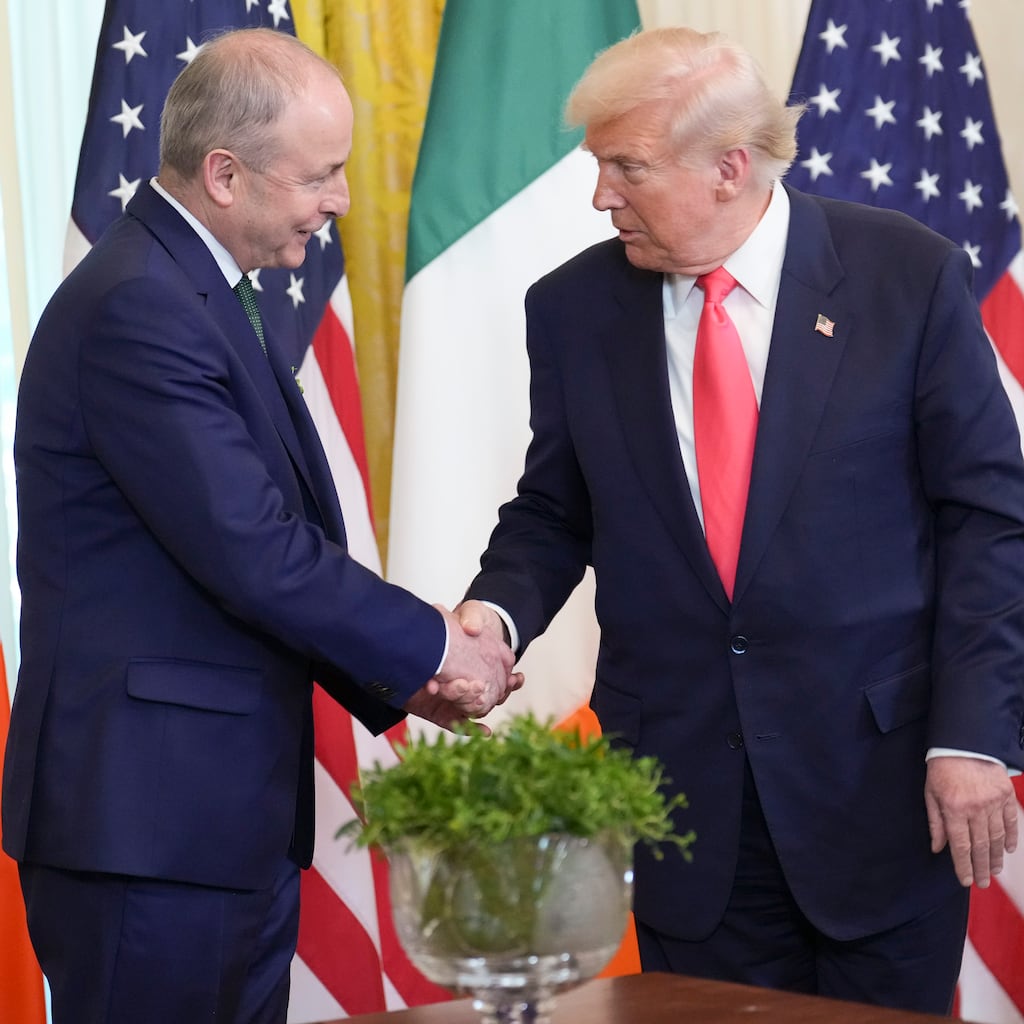
At the same time, she said she expects the Taoiseach to raise Ireland’s concerns about the ongoing assault when he meets US president Donald Trump in the White House on St Patrick’s Day. It will be interesting to see how he articulates that in the presence of a congenitally thin-skinned president.
Martin took criticism at home last year for being too insipid in his public meeting with Trump. In fairness, it took place in the same office where only weeks earlier, Trump and his vice-president, JD Vance, had subjected Ukrainian president Volodymyr Zelenskiy to a political mugging. That encounter was so brutally fresh in the memory that you almost expected to see yellow tape cordoning off a crime scene in the Oval Office.
This week, we saw the German chancellor Friedrich Merz, normally a front-footed political pugilist, sit passively in the Oval Office as Trump publicly rebuked EU allies. Spanish prime minister Pedro Sanchez was berated for publicly opposing the military strikes on Iran. Trump also belittled British prime minister Keir Starmer with a stinging putdown: “This is not Winston Churchill we are dealing with.”
Martin faces a nerve-racking assignment in Washington. Too strong a criticism risks baiting the bear; too cautious a tone will lead to accusations at home that Ireland is being obsequious.


