Cupra, as a brand, really is supposed to be Alfa Romeo.
Let me explain. In the dim, dark recesses of vehicular history, the late overlord (chairman just doesn’t sum it up quite right) of Volkswagen Group, Ferdinand Piech, wanted to buy Alfa Romeo.
Rebuffed in his efforts to do so, he instead decided that VW’s Spanish brand, Seat, would become an Iberian Alfa, all sporty and stylish.
For a company whose profit margins were, at the time, coming from humble Ibiza hatchbacks and Alhambra MPVs, that seemed like a bit of a stretch.
READ MORE


Eventually Seat took its high-performance badge, Cupra, and turned that into a new brand all by itself. Seat was left to very nearly wither on the vine while Cupra thrusted ahead to success.
Now, the brand is so well-established that it’s being given the lead role when it comes to introducing VW Group’s critical new affordable, front-wheel drive electric car platform.
Indeed, Cupra is responsible for actually making not only the Raval, but also the Skoda and VW models that share its mechanical bits (all are made in Cupra’s factory in Martorell, just outside Barcelona).

But it’s the first of the brands to put its precious new car into the cynical hands of motoring hacks. I suppose it’s like opening a play off-Broadway; letting the more niche brand handle the initial plaudits or brickbats before VW itself has its turn.
Which is potentially risky. Cupra has done well for itself, but I wonder how much impact it has truly made with the car-buying public.
After all, Alfa Romeo is almost spectacularly unsuccessful at actually selling cars, but mere mention of the brand makes car enthusiasts all misty-eyed and romantic. Sales figures are one thing, but does anyone yet boast of owning a Cupra?
They might. And if they haven’t yet, then they might with this Raval because this is an affordable electric car that can give lessons to more than a few combustion-engined rivals when it comes to proper driving fun.
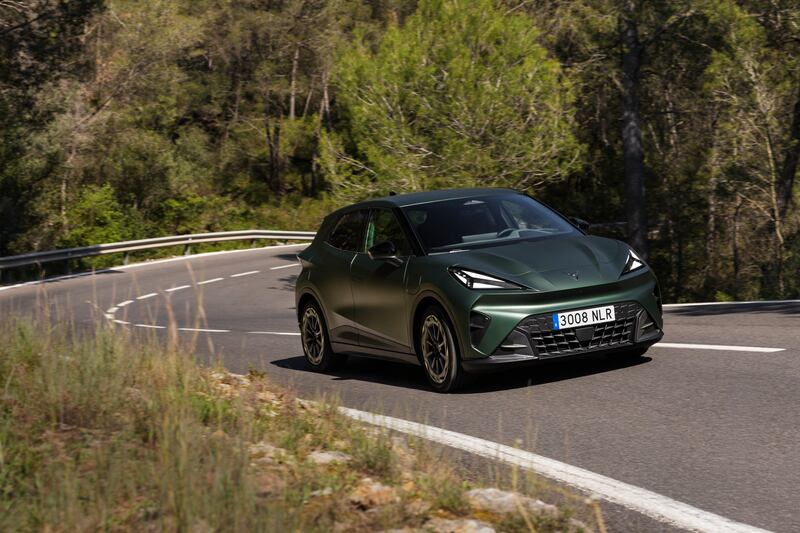
Okay, so the Raval isn’t the best-looking of the three new compact EVs. It tries to be all edgy and cool, with the matte paint options and the glowering “three triangle” LED light signatures front and rear.
Its beaky look is close enough to that of the Urban Rebel concept car that previewed the Raval a couple of years back, but there’s no disguising the fact that it’s a pretty conventional small crossover.
VW’s ID Polo hatch essays a cleaner, neater, albeit more conservative look. Skoda’s Epiq is chunky and more upright.
The Raval is trying just a bit too hard to be cool, like a middle-aged guy with a spray tan and a skateboard.
That’s true of the cabin, too, where there are too many competing surfaces and materials for the Raval’s dash to feel properly cohesive. It’s as if they just kept having more and more ideas and didn’t know quite when to stop, forgetting the cardinal rule of always taking off one accessory before leaving the house.
Yet the fundamentals are right. Our VZ-spec test car – the sportiest and most expensive version – gets fantastic high-backed bucket seats, clad in a modish recycled material that reminds one of the Hi-Tec trainers from years back.

There’s digital impressiveness too, with the same 10-inch instrument panel as in the updated Born hatchback, and the 12.9-inch touchscreen infotainment system uses a new Google-based operating system that’s easier to use. It could still do with a visit to the Physical Buttons Warehouse, of course, but then that’s true of almost every car now.
Space is decent. There’s room for tall adults in the back – and the boot, at 441 litres, is positively huge for a car that only just breaches the 4.1m mark.

So far, so conventional. And there’s more convention under the skin. Unlike the VW Group’s existing electric cars – all of which are based on a rear-wheel-drive platform – the Raval and its brethren switch to front-wheel drive.
You can choose between two batteries. There’s the cheaper 37kWh battery (using the more robust but less efficient lithium-iron-phosphate chemistry) for a range of just over 300km.
Or there’s the pricier NMC (nickel-manganese-cobalt) battery, with 52kWh and up to 448km of range – though in this sporty VZ variant that drops to a slightly less impressive 394km.
The big battery model takes as little as 24 minutes to charge from 10-80 per cent on a DC charger.
Power ranges from an adequate 116hp in the basic model, via 135hp and 211hp versions, up to the 226hp of this VZ.
Those figures remain broadly the same no matter which of the new compact VW Group’s electric cars you choose, but Cupra is trying to underline its more inherently sporty nature with some actual, physical differences.

The Raval is 15mm lower and more stiffly sprung than any of the others, save for the incoming ID. Polo GTI, and even then the Cupra has suspension that sits 10mm wider apart for a little more of what the kids call “stance”.
The VZ model (from the Spanish “veloz”, or “speed”) gets variable ratio steering, which feels rather pleasantly natural and informative and is far more chatty to your palms than those of most other small EVs.
The sporty suspension thankfully doesn’t result in a clattered spine, as the Raval VZ is firm but always yielding. The brakes are genuinely exceptional, shrugging off the too-spongy feel that afflicts the larger Born and Tavascan models, and instead feeling solid and responsive, which gives you much more confidence when approaching corners.
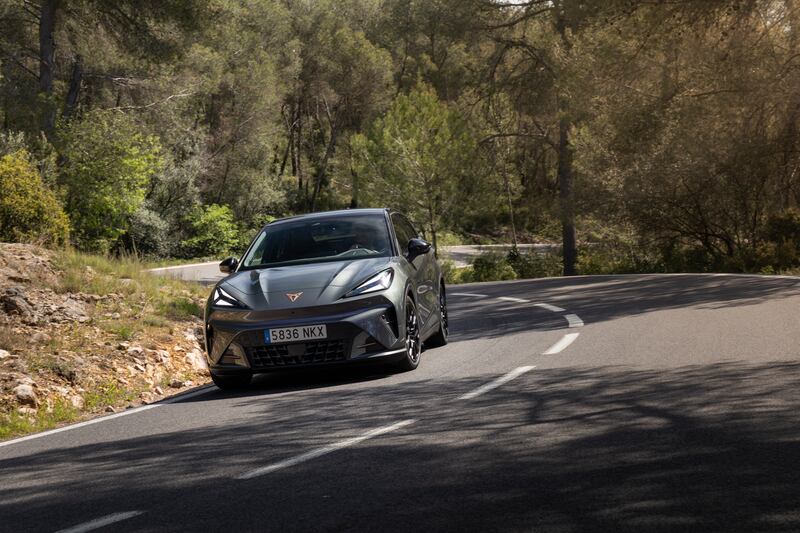
Through those corners, the Raval is just plain fun. There is no need to use the qualifier “for an EV”.
This is properly good fun to drive, a classic hot-hatch but without the wheezy 1.6 petrol or the attendant fuel bills.
The Raval feels agile and pointy, and rotating apparently around the driver’s hips as you pitch the nose into an apex. It helps that, by EV standards, the Raval is relatively light (1,600kg or thereabouts) but while many predict the eventual supremacy of the Chinese brands, none of them have yet shown the ability to create a car that’s as genuinely enjoyable to drive as the Raval. See what I mean about boasting that you own a Cupra?
You can even boast that it was good value. Prices for the most basic model start at a hair under €25,000, although obviously you’ll pay more like €36,000 for this VZ, which seems somehow reasonable in today’s car pricing world. Hopefully its driving manners will translate to lesser Ravals, which do without the VZ’s impressive adjustable suspension dampers.
If they do, then maybe the Raval will be the car that makes that odd, pronged Cupra badge really mean something. The only worry is that the VW ID Polo is right there, waiting in the wings to steal its thunder.


