
I found quite a large and unusual-looking moth in our polytunnel and was wondering what it was. Sanne Gielesen, Glendine, north Co Clare
This is a Poplar Hawkmoth. It is easy to identify because at rest the hindwings project well in front of the forewings. It does not feed as an adult. It flies from May until September in two broods. Its large bright green caterpillar with a yellow horn feeds on poplars and willows. It overwinters as a chrysalis in the ground.

We discovered these strange-looking bees crowding into an empty bird-box in the orchard. They do not seem to fit the description of any of the other bees we see here. Sometimes there is much more of them than in this photo. What is the story? Noreen Lyons, Portumna, Co Galway
This is the Tree Bumblebee, Bombus hypnorum. It looks like a Common Carder bee with a very white tail. Following its spread from France and across Britain, this species was first recorded in Dublin in September 2017 – an expansion of its range due to climate change. It has now been recorded all across the country. Tree Bumblebees nest high off the ground, often in trees and in other high places such as in bird nest boxes, and so these pollinators do not compete with Ireland’s native, ground-nesting bees for space. Let them nest in the bird box and put in a handful of garden compost if you are setting one up specially.
READ MORE


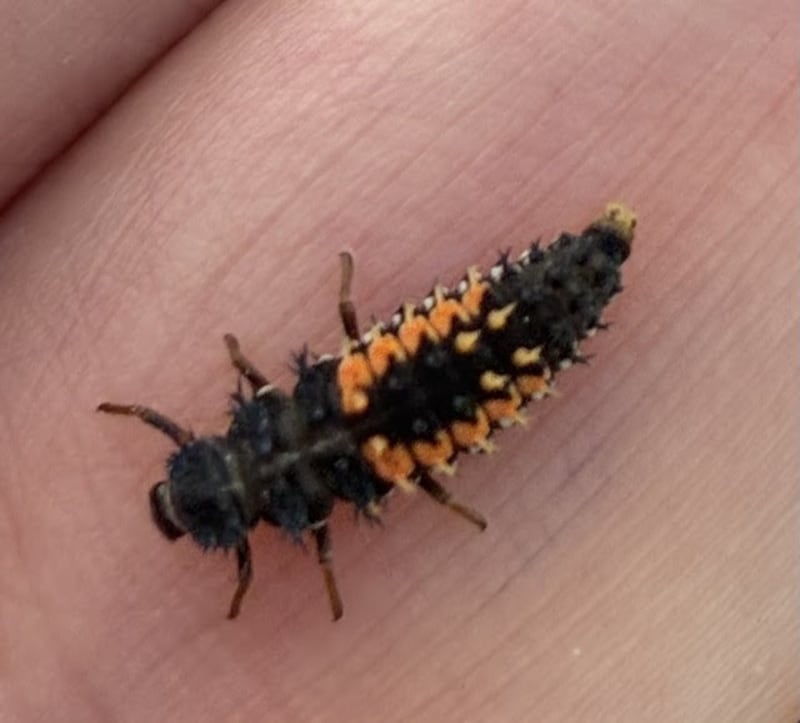
This colourful critter crawled up my hand while I ate my lunch in tropical Dublin during the good weather at the end of May. My grandson and “bugologist” Beau Martin awaits your reply. Steve Petherbridge, Swords, Co Dublin
Give your curious grandson his proper title – entomologist- and there will be no stopping him. The news on the larva however is bad. This is the young larval stage of the Harlequin Ladybird which is characterised by the spikes all over its back. It is an invasive species which is very common here now and which eats our own native ladybirds in their larval states.

These creatures were attached together on a reed in the garden pond. They flew away still attached. What are they, and what is going on? Seamus O’Braonain, Ballydavid, Co Tipperary
What do you think is going on? They are mating of course! This is a pair of Large Red Damselflies – the first species of damselfly to appear every year, and it is quite common wherever it can find clean water with lots of dissolved oxygen. The male, which is at the front, grabs the female behind the head with its claspers. The female curls her body under him to receive the sperm from the segment just below his wings and then they fly off in tandem, as in your picture. He holds on to her firmly and lowers her down to submerged vegetation, where she lays the eggs in batches of about 350.

What are these caterpillars? They have completely covered the tree with a web that looks like the tree is wearing a silk stocking! There are no leaves left on the trees. Maureen Hastings, Rathfarnham, Co Dublin
What an elegant description. This is an ermine moth – probably the Orchard Ermine, Yponomeuta padella. If you touch one on the head, it will wiggle backwards. Together with its many companions, it feeds on hawthorn, blackthorn and cherry plum, and can completely defoliate the tree. They cover the tree with silk webbing as you have observed, and this protects them from being eaten by birds. They will eventually drop off, pupate and fly away as adult moths. The tree will recover and regain its foliage.
Please submit your nature query or observation, ideally with a photo and location, using the form below or via irishtimes.com/eyeonnature or by email to weekend@irishtimes.com


