
A regular visitor to our location – the red-bellied black snake. This one was seen crossing the roadway outside our home. It appears regularly when the weather starts warming up. I trapped this one in a bucket and released it behind our residence. John Groarke, Long Beach, New South Wales, Australia
I must admit I did a double take until I saw your address. I take your word for it that it is a red-bellied black snake, as your photo only shows its back not the red sides and belly. Apparently – while it is a venomous snake – they are generally shy, calm, and nonaggressive, preferring to retreat from human encounters. They will only bite if threatened. Moving it on in a bucket was probably the best move. We have no native snakes in Ireland. We had separated from Britain before our neighbour’s three native snakes arrived there – before the first Brexit after the Ice Age.

You may be able to help identify the hovering ‘bug’ in the attached photo. I spotted it in my garden visiting purple blossoms with its proboscis. It hovered at each flower and looked like a butterfly with small wings which flapped like a hummingbird’s. John Sheeran Stameen, Drogheda, Co Louth
Verena Sheehan in Leopardstown in Dublin saw the same insect in her garden during the recent spell of fine weather and it is her picture that is printed here. This is a hummingbird hawk moth – a day-flying moth that is a summer visitor to Ireland. It arrives from farther south in Europe during hot weather. It feeds on nectar from flowers. It can breed here too but it is too cold yet for it to overwinter.
READ MORE


I was cleaning out the greenhouse and shifted a large pot. Underneath was this creature, which looks like a cross between a cattle tick and some sort of incipient spider. Can you help me identify it please? Deirdre McDermott, Rossadillisk, Co Galway
It is a woodlouse spider. This is a slow-moving nocturnal hunter that preys entirely on woodlice, which it spears with its huge fangs. Don’t handle it, as those same fangs can inflict a painful bite on us too.
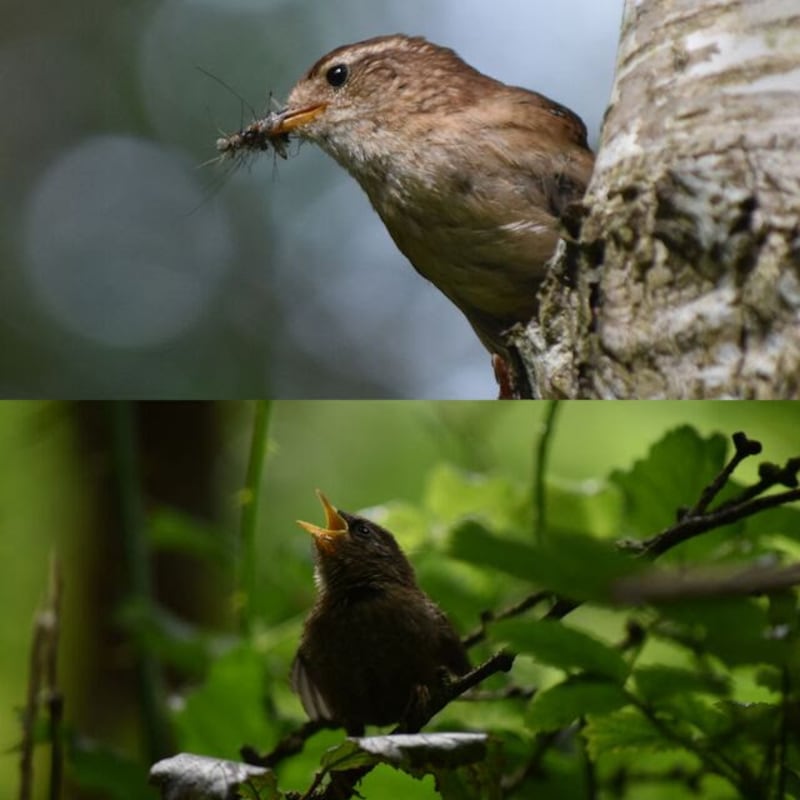
I’ve been watching this wren’s nest for a few days. Two days ago they fledged and today when I went to look for them I found one in a nearby bush calling for his mother who was in a tree above holding a number of flies in her beak. I think they are really good shots (well I think so anyway). Pearse Naughton, Sean Walsh Memorial Park, Tallaght
They are indeed most excellent shots of our second smallest bird, the wren, often difficult to see. Wren nestlings leave the nest as soon as they think they can fly, but then they have to depend on their parents to bring them food for the next three weeks as they skulk around the garden calling out to be fed. They have not fallen out of the nest or been abandoned by the parents as indeed your image of the female with a mouthful of insects so clearly shows.

I found this large moth hiding under a picnic table. What is he? David Pasley, Monkstown, Dublin
This is the angle shades moth. Its forewings have a somewhat ragged and distinctly concave outer margin and a V-shaped band across the middle of each one, which make it very easy to identify. They are frequent in May and June and again in August and September, when their numbers can be augmented by migrants from farther south. Their caterpillars feed on the leaves of a variety of shrubs and plants and winter is passed mainly in the caterpillar stage.
Please submit your nature query or observation, ideally with a photo and location, via irishtimes.com/eyeonnature or by email to weekend@irishtimes.com
Please submit your nature query or observation, ideally with a photo and location, using the form below or by email to weekend@irishtimes.com


