Thousands of students began their Leaving Certificate and Junior Cycle exams yesterday. Teachers praised Leaving Cert English paper one as a “lovely” exam, while there were no surprises within the ordinary level paper.
Home economics candidates were presented with a “challenging but fair” paper at higher level and a “student-friendly” offering at ordinary level, teachers said.
The second day of exams kicks off with engineering at 9.30am and English paper two follows at 2pm.
Key reads
- Number sitting Leaving Cert climbs to record level
- Leaving Cert: 10 tips for parents supporting an exam student this month
- Watch: Exams, points and planned celebrations: students on the exams
- ‘I’m going to do medicine’: Student who left school in second year now aiming for top points
- Sign up for our Classroom to College newsletter
We’re going to wind down today’s live story now. Thanks for staying with us on day two.
Tomorrow will see students taking on Geography and Maths (paper one). We will be back with all the latest updates then.
Best of luck!
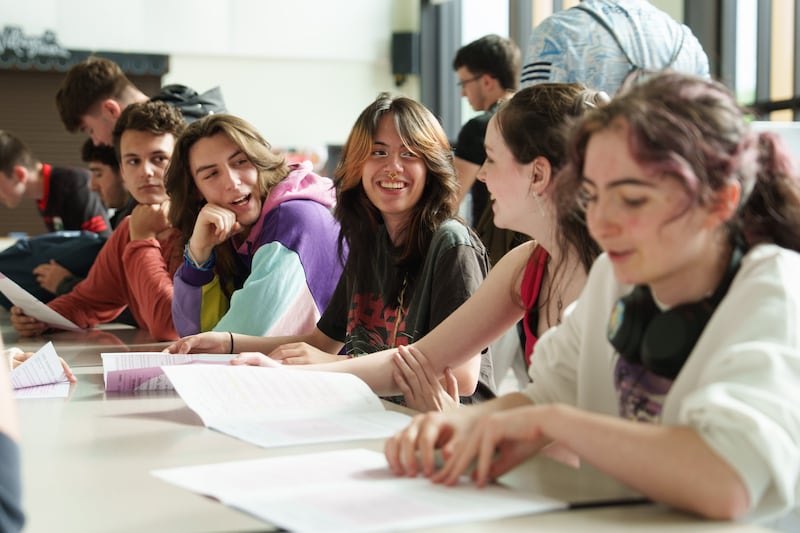
Our reporter Jack Brady has more reaction to English paper two.
Gillian Chute, head of English at The Tuition Centre in Dublin, said the paper struck a “commendable balance between accessibility and challenge” in which students’ full range of English skills would have been tested.
“A thought-provoking yet manageable paper for the well-prepared candidate,” she said.
Liam Dingle, a teacher at the Institute of Education, said paper two “challenged candidates to navigate the specifics of the question while also offering them a movable feast of material”.
Dingle said the appearance of poets Paula Meehan and Elizabeth Bishop would have given students a “little moment of triumph” before taking on the exam.
Read the full report here.
Students ‘very happy’ with English paper two
Siobhán O’Donovan, a teacher at the Patrician Academy in Mallow, Co Cork, said students were “very happy” with the English exam overall as they faced “no curveballs”, Jack Brady reports.
“I don’t think anyone had any major problem with the exam,” O’Donovan said of the higher level paper two on Thursday.
“It’s lovely to see them coming out happy,” she said, adding it’s not always the case that students leave the exam hall with smiles on their faces.
As for the ordinary level paper, O’Donovan said there was one “tricky” element of the single text question where students were tasked with arguing in a debate about AI.
However, O’Donovan said students were happy overall with the level of choice for the majority of the paper.
“Students at ordinary level too emerged from the exam hall tired but happy with the contents of their paper, with one student saying it was ‘very straightforward’.”

As the dissection of day two begins, let’s take a trip down exam memory lane with Fiachna Ó Braonáin.
The musician and broadcaster sat his Leaving Cert exams in the summer of 1984.
His most vivid memory of that time is “staying up very late at night in my bedroom, drinking many cups of coffee, and cramming each night before an exam”.
Ó Braonáin went to university “for a year and a bit, but then took leave of absence to pursue a life in rock’n’roll”.
Read his full interview with Tony Clayton-Lea here.
The English papers have been published on the State Examinations Commission website now.
The higher-level paper is here.
The ordinary-level paper is here.
‘A very fair paper’: Reaction to English paper two
Jen Hogan has a first take from teachers on their thoughts of English paper two, which finishes at 5.20pm:
The hotly-tipped Paula Meehan made an appearance on higher-level English paper two, but although the question itself about the poet was “easy enough”, the word “modulate” may have thrown some students, says Lisa Carley, an English teacher at Drimnagh Castle in Walkinstown, Dublin 12.
“On first glance it’s a very fair paper,” she says. Elizabeth Bishop, WB Yeats, Eiléan Ní Chuilleanáin and John Donne were also in the poetry section.
“While I think everyone will be happy because the poets people wanted came up, they’re still very specific,” Carley says. “The Bishop question is there but it is asking you to focus on her troubling and unsettling poetry, which is asking you to narrow the focus a little bit. Because a lot of Elizabeth Bishop’s poems are quite uplifting and optimistic.”
The paper “looks very doable, and it is very doable, but I think there’s definitely questions that require students to have really engaged with the prescribed texts”.
“The Macbeth question is about how you heighten audiences’ feelings of sympathy for the central character. And most students wouldn’t have felt any sympathy for Macbeth, so it’s inviting them to disagree with that question. But you have to be quite confident in your abilities to disagree with the question in the first place.”
“They’re also focusing on dramatic techniques,” she says, something that would have likely been “drummed into students”.
“In the other single text they’re asking them to think about the craft of writing or the craft of storytelling.”
They’re nice single texts, Carley says, “but things students would have to think about in good detail”.
For the comparative question, Carley describes the cultural context questions as “lovely”.
“They’re asking them about aspects they would have gone through in class a lot, like social class and there’s one on a patriarchal and male-dominated society. Really easy, really nice.”
The general vision and viewpoint questions were quite tricky, though, she says, “even just the way they’re phrased”.
The literary genre questions were “not too unusual”.
“This is the higher-level paper so they are going to put in questions that make kids think a little bit more, or to give them questions that basically reward students who are able to think a little bit outside the box and not just go in with their rehearsed answers.
“The paper will really reward the students who know their texts and who engage with their texts really well.”
Carley says the ordinary-level paper was also very fair as well, with the single text questions offering a lot of “creative choice”.
Lots of choice on the paper means there was something for everyone, she says. She thinks students will overall be happy with both papers.
Reaction is in from engineering, and our reporter Jack Brady has been speaking to teachers
Eamon Dennehy, an engineering teacher at Heywood Community School in Co Laois, said students would have been “familiar with the context of the paper” – the real challenge was bridging the gap between the science and the quotidian.
“I didn’t come across anything you could count as unfair,” Dennehy said, adding that question one’s inclusion of Dyson hand dryers and upcycling would’ve been received well by students.
Dennehy said overall students would’ve had to “fully understand the paper to fully contextualise the questions”.
One of the more challenging questions was part of question six that related to welding, which wasn’t expected and relied on students “applying their knowledge”.
Apart from that, there were no significant curveballs for students and much of what was on the paper was expected, said Dennehy.
The “modern” and “fair” paper was particularly relevant to students through its “topical” questions.
Cara sits ‘real’ Junior Cycle exam - four years after autism campaign
By Louise Walsh
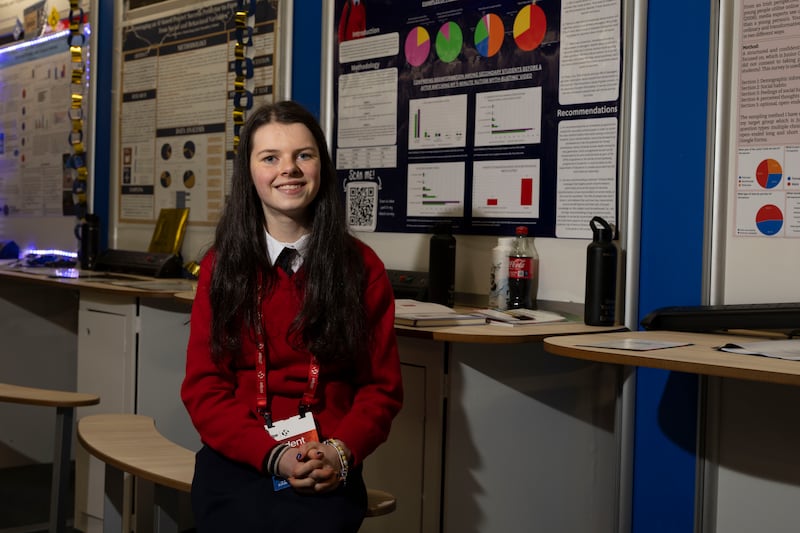
A disability rights campaigner who sat a Junior Cycle maths exam when she was just 11 years old is doing it again – for real – this week as part of her Junior Cycle exams.
Cara Darmody, a 15-year-old girl from Co Tipperary, will sit the maths exam on Friday.
“There is a lot of pressure but I have high expectations of myself. I will just go in there and do my best. Maths is my favourite subject anyway and I really enjoy it,” she said.
It will be four years after she obtained 97 per cent in the paper she took while still in national school in order to raise awareness about the lack of services afforded to children with additional needs.
Her two younger brothers, Neil and John, have intellectual disabilities and autism.
The teenager was also the youngest person in Ireland to pass Leaving Certificate maths when she was 12 years old.
She received the same high grade of 97 per cent at ordinary level in that exam.
Her campaign raised a total of €82,000 for autism services.
In the last 2½ years, she has staged a number of 50-hour protests outside Dáil Éireann and attended more than 50 ministerial meetings.
The Government created “Cara’s Fund” in her honour to deal with the assessment of needs crisis and the Ardfinnan resident has managed – so far – to secure more than €37 million for assessments for 10,000 of the 23,000 on waiting lists
In a letter last October, Tanaiste Simon Harris wrote to Cara, confirming that “Cara’s Fund” had been doubled from €10 million to €20 million as part of the budget.
Cara’s parents, Mark and Noelle, said they were worrying for Cara ahead of the exams and were glad they had started.
“She doesn’t do pressure, we have been worrying for her.
“We are incredibly proud of her but sometimes we are afraid that she isn’t getting to be an ordinary 15-year old. She shouldn’t have to prepare for ministerial meetings to try and secure funding for government failings but she wants to do it.”
The Leaving Certificate exam papers for engineering have now been published on the State Examinations Commission website.
You can access the higher level paper here and the ordinary level paper here.
What do we hope comes up on English paper two? ‘Paula Meehan number one’
English paper two is up this afternoon and after a well-received paper one yesterday, teacher Sarah Doyle from Holy Family Community School in Rathcoole, Co Dublin, knows what she’s hoping for. “Simplicity, clarity, directness, accessibility. A chance to do well,” she told Jen Hogan this morning.
“Paula Meehan would be number one” when it comes to the poet students hope will appear on both the ordinary and higher-level papers, Doyle says. “Just because they love the poetry. It’s so accessible. It’s story-telling and she’s just so easy to identify with.”
Some students really enjoy WB Yeats and will be hoping he’s on the paper, she says. “Some of them would be history buffs. So there’s a huge historical context there.
“Macbeth is the single text for a huge amount of the higher-level students. You’re just looking for something with clarity. A question that’s easy to understand. A question that doesn’t have a really difficult word in it that’s going to throw them.”
“Usually you’ll get a character question and a theme question. So you’re just looking for a simple version of one of them. Because sometimes the concepts are actually not so difficult but the way it’s dressed up with words can be difficult for a lot of kids,” Doyle says.
She says the decrease in reading among young people means “they don’t have the same vocabulary skills”. This is something the English paper doesn’t always seem to reflect or take account of, she says. “The paper hasn’t moved in the direction that the students have moved in. It’s almost like it’s trying to catch them out the last few years. Any English teacher will tell you literacy levels have plummeted, and the paper hasn’t adapted in any shape or form to move with that.”
The comparative is sometimes considered the worst question, she says. The question itself is very long and can be very challenging for students with literacy difficulties or dyslexia.
Paper two is three hours and 20 minutes long, but this is no bad thing, Doyle says, as it gives students “room to think” and consider.
“Stay until the end,” she says.
Leaving Cert advice from a guidance counsellor
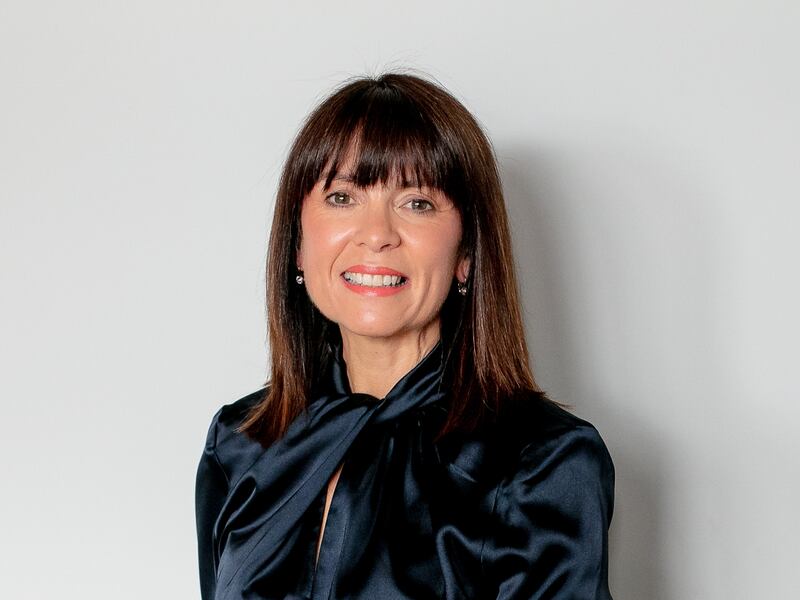
Niamh Dwyer is a career guidance counsellor and a parent of three, with her youngest child currently sitting the Leaving Certificate exams.
As an expert professionally, and in the veteran Leaving Cert parent sense, she knows what awaits.
For the students, she says, “it’s about striking balance. A balance between what I’d call routine and rest.”
Students should really focus “on what they know” rather than what they feel they don’t, she told Jen Hogan today.
You can read the full article here.
Engineering has started, with the ordinary level paper finishing at 12pm and higher level at 12.30pm.
We will share the papers here when we have them and my colleague Jack Brady will have reaction from teachers when it finishes.
As for the A-levels? They don’t compare, according to Finn McRedmond.
“I remain full of praise for the Leaving Cert system – believing it to be of considerably greater value than its UK counterpart, the A-levels,” McRedmond writes in her column today.
“But my greatest criticism of the Leaving Cert? Perhaps it is not robust, rigorous or difficult enough,” she says.
Phew, that’s grand when you’re not the one sitting it.
What do you think about that?
You think the Leaving Cert is hard? Try the gaokao
Almost 13 million students in China will start the gaokao on Sunday.
It is the world’s biggest exam and by some measures the most psychologically challenging, according to our China Correspondent Denis Staunton, who wrote this fascinating piece about the exam.
“It’s very tiring. The competition is intense. Every day feels exhausting. The feeling is that it’s tiring and difficult,” one of the students said.
This is the first year that students who qualify for the Reasonable Accommodations at Certificate Exams scheme get an extra 10 minutes to complete their papers.
The scheme is designed to help students with special educational needs who have difficulty in communicating what they know to an examiner because of a physical, visual, hearing and/or learning difficulty.
Some of these accommodations can include reading assistance, scribes, voice-activated computers and being able to take the exam in a hospital.
Were you one of those students who got 10 extra minutes yesterday? Did you think it was enough?
Let me know by email niamh.towey@irishtimes.com or through our call-out here.
Day two of the Leaving Certificate kicks off with engineering at 9.30am this morning.
English paper two is in the afternoon, starting at 2pm.
Yesterday appears to have started off as smoothly as we could have hoped, with general reaction to English paper one being positive.
Home economics in the afternoon seems to have caused a little bit more of a stir, with some teachers calling it unpredictable.
You can read our full paper reviews for English here and home economics here.
We will be bringing you live reaction to today’s papers here, along with advice for parents and pupils.
I would love to hear from you as the exams go on - you can get me on niamh.towey@irishtimes.com.


