
A Border poll on a united Ireland is “off the table”, Andy Burnham has said on his first visit to Northern Ireland as UK prime minister.
“I am here to listen and to collaborate, but some issues will be off the table, and that is one of them,” he said in response to a question from The Irish Times.
“I see how referenda can really take you backwards because it turns people in on themselves, and arguing with each other, and cause rifts that take a long, long time to heal.”
Instead of a referendum on a united Ireland, politicians should be focusing on issues such as the cost of living, a budget and making people’s lives better, Burnham said.
READ MORE


“I don’t want to be in a position where we are turning backwards, where politics takes over and people’s lives are put on hold as a result.”
Burnham’s rejection of the prospect of a border poll in Northern Ireland was strongly criticised by Sinn Féin leader Mary Lou McDonald, who also met the prime minister in Belfast.
Speaking on Thursday night, McDonald said: “At the core of our discussion with him has been the Good Friday Agreement and the provision for a referendum on Irish unity.
“We have made it very clear to the British prime minister that the right to referendum, the right for Irish people to decide our future, is one that is contained within the Good Friday Agreement and is a commitment entered into and a matter of international law, and he simply does not have the right to dismiss or disregard that commitment.”
The Belfast Agreement stipulates that it is up to the British government’s Secretary of State for Northern Ireland to call a referendum in the North, and that the person shall call one if it seems likely the poll would be passed.
But successive British governments have declined to say on what grounds they will make the judgment that a vote is likely or unlikely to pass.
While evidence from repeated opinion polls suggests a vote is unlikely to pass at present, pro-united Ireland campaigners have urged the two governments to prepare for a border poll and for eventual unity.
Government Buildings declined to comment on Burnham’s remarks, though sources stressed a collaborative approach between Dublin and London.
Burnham also reaffirmed the British government’s commitment to deal with legacy issues through the Troubles Bill. The Bill would be brought back to parliament in the autumn, he said.
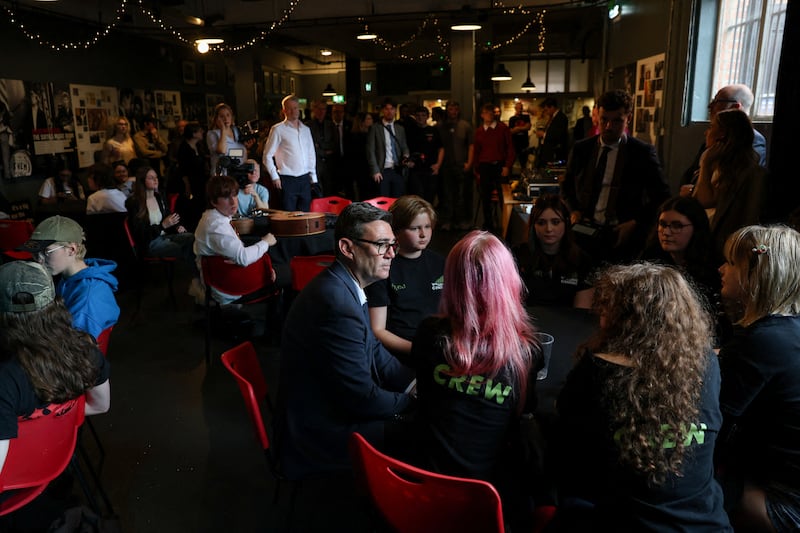
“To abandon it would be the wrong thing to do,” he said.
As part of his half-day trip, Burnham met First Minister Michelle O’Neill of Sinn Féin, Deputy First Minister Emma Little-Pengelly of the Democratic Unionist Party (DUP), and other party leaders from Alliance, the Ulster Unionist Party (UUP) and the Social Democratic and Labour Party (SDLP).
Finance is one of the key issues for the party leaders. Despite a deadline of early April this year, the Stormont Executive has failed to agree a budget with politicians, claiming there is a shortfall of £1.6 billion (€1.9 billion).
[ What does Andy Burnham taking over as British PM mean for Northern Ireland?Opens in new window ]
Burnham said he wanted to help resolve the budget issue, but gave no detailed commitment on how that might be done, nor a promise of additional finance.
Asked would the British treasury “bail out” Stormont, he said: “I don’t think I can give you a hard yes or no answer to that question today. I don’t think it’s unfair of the treasury to say: Why is the budget in the position that it is in? Is there something that could be done to do things differently, to make some savings?”
He said it was legitimate of the treasury to create “fiscal discipline in all parts of the UK”. Equally he said he did not want things to drift, and wanted to help in moving “Northern Ireland forward”.
Matthew O’Toole, SDLP leader at Stormont said his party made clear to the prime minister that the provisions of the Belfast Agreement mean the people of Ireland, North and South, would decide the future of the island.
“In the shorter term, he should be focused urgently on securing an Executive Budget and reforming a broken Stormont to rescue devolution,” he said.
Ivana Bacik, Labour leader, said she was disappointed by such a categorical statement.
“We in Labour have said that preparatory work should get underway towards planning for the future holding of a unity referendum, and we would continue to urge the Irish Government to commence carrying out preparatory steps, despite this statement from PM Burnham today.”


