
The Royal College of Surgeons in Ireland has maintained an imposing presence on St Stephen’s Green for 200 years, with a palatial neoclassical facade befitting such an august institution. By comparison, its mould-breaking building farther along the west side of the Dublin square is so startlingly cubist in style that it invokes a sense of shock and awe.
Interposed between WH Lynn’s modest Gothic-style Unitarian Church, from 1863, and a fine pair of mid-18th-century houses designed by Richard Cassels – one of which was occupied until recently by the Shanahan’s on the Green restaurant – the new RCSI building replaces Block A of the Ardilaun Centre, an early-1980s office complex that used to be Telecom Éireann’s headquarters.
The college, which now styles itself as RCSI University of Medicine and Health Sciences, needed more space as student numbers expanded. It had already developed a superb new building at 26 York Street that deservedly won several awards for Peter McGovern and his team at Henry J Lyons, Dublin’s biggest and busiest firm of architects.
The extremely complex brief for that project involved shoehorning a diverse range of facilities, including a library on three floors and a tiered lecture theatre and sports hall below ground level, into a tight site on a relatively unimportant side street. Much more challenging was the conundrum of doing something similar on St Stephen’s Green itself.
READ MORE


This was seen by the RCSI’s chief executive, Prof Cathal Kelly, and its architects as an opportunity to create a new “front door” on to the Green and project a contemporary image of the college as a progressive institution that aims to be one of the world’s top medical universities, educating students from every continent.
“Making a building on St Stephen’s Green is a rare privilege,” McGovern says. So one of his early moves in designing the new block was to “fold back” the upper levels of its multilayered, multiplaned elevation to reveal more of the Unitarian Church’s slender spire, at least in close-up views; from Fusiliers’ Arch, at the Grafton Street entrance to the St Stephen’s Green park, only the tip is visible.
Exploiting the jagged building line on the Green’s west side, the RCSI’s latest addition was intended to have “a presence that isn’t demure and recessive”, in the words of its architect, but rather to be “both striking and respectful to its context, expressing itself boldly on the streetscape while at the same time folding to reveal and recognise its neighbours”.
This deference is not obvious in its relationship with the adjoining Georgian houses, as the facade rises above their parapet height, although it does avoid crashing into Cassels’s chunky cornice. Indeed, An Taisce complained that it “breaches 60 years of planning policy in maintaining a uniform parapet height around St Stephen’s Green”.
But Garrett Hughes, a senior planner at Dublin City Council, believed the “distinctive contemporary design” would “make a positive contribution to the subject site and Dublin’s urban fabric”. An Bord Pleanála agreed, saying it “would not detract from the visual amenities of the area or the character and setting of the adjoining protected structures”.
The board’s February 2020 order, signed by its then deputy chairman, Paul Hyde, upheld the council’s decision to omit an eighth storey at the rear. A subsequent application to reinstate it was rejected by both the council and An Bord Pleanála, with the latter ruling that it would have a “significant and detrimental impact on a number of important views and vistas”.
The extensive use of fritted glazing gives the building an “ephemeral quality”, McGovern says as we view it from within St Stephen’s Green, noting its “lightness through the trees”. He points out that the building’s appearance “changes throughout the day as sunlight falls on the vertical fins [on its facade], and this creates texture and shadow”.

There’s also a tall rectangular clear-glass window, framed concavely in Portland stone; facing southeast, it provides excellent daylight for two floors, including the RCSI’s new boardroom. Above and beyond, set back from the parapet, are the upper levels of this 12,000sq m building, also visible through a narrow gap beside the Unitarian Church.
The double-height angular facade above the ground floor projects over part of the footpath to create a modernist portico, as if to invite people in. And, indeed, the airy, double-height foyer has been given the name Humanarium – an aquarium for humans, perhaps – where there’s a cafe open to the public and a set of screens for regular health-themed exhibitions.

Behind the foyer is an expansive room that’s designed to be used for public functions, such as evening lectures, as well as for teaching. Everything else in the building is accessible only by swipe cards, including a double-height “learning studio” and breakout space in front, with lounge-style seats looking out towards the Green’s tree canopy.
McGovern has got to know that RCSI students spend more time on campus than those in other universities. “It’s a kind of a home from home, so they can almost hang out here in a way,” he says. There’s even a Spás Meabhrach/Mindfulness Zone, with soft furnishings and circular curtains that can be drawn for more privacy to meditate.
It’s probably needed because of “the intensity of medical studies and the pressure on young students”; McGovern sees it as part of the RCSI’s “strong pastoral element” in looking after them, particularly those who are a long way from home. More than half of the college’s 4,500 students have come to Dublin from abroad, representing more than 60 countries.

“The collaborative nature of learning in medical courses is really important,” he says. So there are lots of spaces to encourage peer-to-peer interaction. A small south-facing amphitheatre opens into the college’s first outdoor space, a landscaped garden bordered by Block B of the Ardilaun Centre, with an art installation by the sculptor Rachel Joynt.
The Dispensary, a cafe dedicated to serving the students, is ready to go when they move in after Christmas. And, naturally for a €90 million development called Project Connect, there’s a direct link to the three-floor library at 26 York Street – so seamless, indeed, that it’s hard to tell when you’ve moved from one building to the other.


The lower floors are connected by two white-painted spiral steel staircases, one of which is visible from York Street as you look down Proud’s Lane. A set of gates, currently padlocked, are to be opened up to provide another route into the new block. A pair of mews on the dog-legged lane are dwarfed by what has been built around them.
Apart from a bronze mesh screen on the south-facing rear elevation of 26 York Street, the materials used in the latest building are quite similar – white brick and metal work, white-dot fritted glass for reflectivity – with the introduction of Portland stone, which McGovern prefers for its fossilisation, rather than using Portuguese limestone.
There’s a clear view of the large pointed arch window, with decorative stone tracery, on the side of the Unitarian Church from several levels of one of the main circulation areas inside the new block. This is largely due to an old legal covenant requiring that its right to light had to be respected, and serves as a reminder of the sensitive setting.
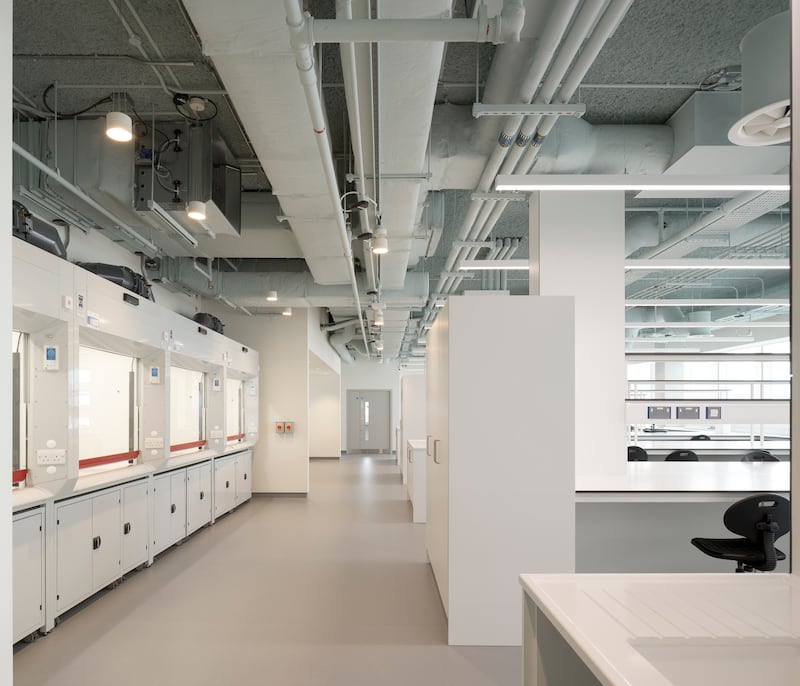
Nearly half of the RCSI building is given over to postgraduate research and laboratory work, with the college’s graduate school of medicine moving in from Sandyford, in the south of the city. The top-floor laboratory has glass-screened “fume cupboards” for conducting experiments with potentially toxic chemicals, and there are extra-large ducts to take the fumes away.
On every floor, lift shafts are faced in board-marked concrete, adding texture to the generous circulation areas where everything is clearly signposted. Functions can also be catered for in a big room on the fifth floor of the St Stephen’s Green frontage that has a “finishing kitchen”; it opens on to a terrace with commanding views of the city centre.
McGovern is happy about what he has achieved with Project Connect, which was partly funded by a €40 million loan from the European Investment Bank. He rejects criticism that the new block fails to show sufficient respect for its historic context and looks forward to replacing what’s left of the Ardilaun Centre “whenever that happens”.
As for the historic parapet line of buildings around St Stephen’s Green, it was first breached back in the 1860s, when the Shelbourne Hotel was dramatically rebuilt and embellished by John McCurdy. Dublin’s quintessential grand hotel has long been a landmark in the city, but the RCSI’s new “front door” on the Green is now in contention for that title.
Frank McDonald, former environment editor of The Irish Times, is an honorary fellow of the Royal College of Surgeons in Ireland


