Born: June 24th, 1943
Died: August 31st, 2026
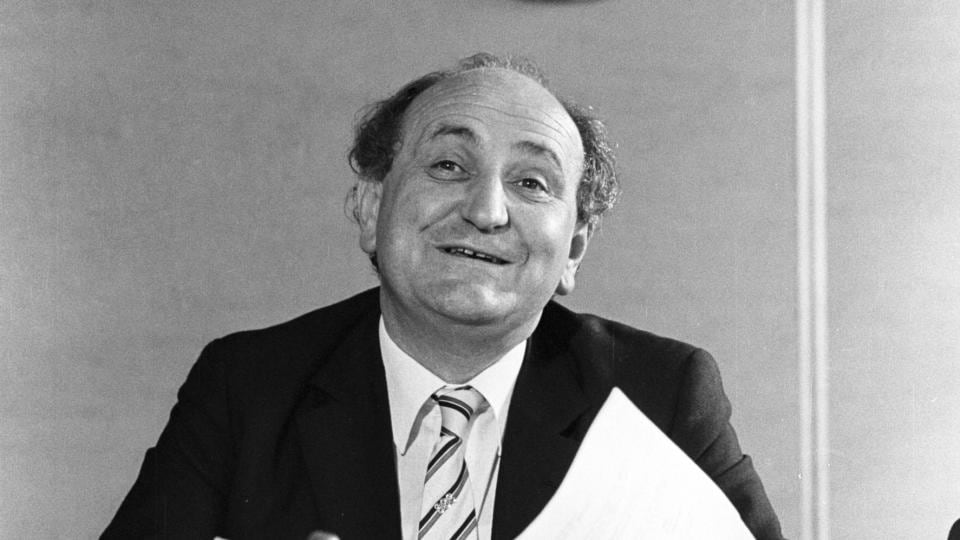
John Schwatschke, the Irish portrait painter who died on August 31st aged 83, introduced a genteel and sometimes surreal ambience into the lives of his friends. His sitters included Éamon de Valera and Prince Philip, but his distinctive caricatures captured the Ireland of his childhood in the 1950s: men in flat caps at the races and riding bicycles, shawled women in curlers and blue eyeshadow gabbling on a bench, musicians sawing away with violins.
“I just find the face humorous,” he said. Even in his final months, he still marvelled at how a slight change of a brushstroke could cheer up a sad face. His characters were imaginary, although, he acknowledged, “sometimes I get into trouble if one of these people arrives in front of me”.
Born in Dublin on June 24th, 1943, John was the younger of two children of Franz Schwatschke, a Moravian-born electrical engineer who was headhunted from Siemens to become chief engineer at Carlow’s sugar factory. He arrived in Ireland 100 years ago, in September 1926, and sought an English teacher. He was duly introduced to Charlotte Meredith, known as Lottie, who as well as teachingt him English became his wife in 1930.
Franz’s ingenuity extended well beyond the sugar factory. In 1952, the Electrical Review described his domestic arrangements: “If he wants to listen to the radio, Mr Schwatschke turns on the cold water tap in his kitchen; if he wants to light a cigarette, he just leans towards the table lamp.”
READ MORE


Franz also devised a water bike, tested on the Barrow, and nearly perfected a “paddle shoe” that would have enabled one to walk on water. On summer evenings, he played the zither and sang German songs to the family pets.
Lottie was a fun-loving prankster in her own right. She and Franz welcomed a daughter, Ann, in 1933. Ann enjoyed 10 years as the centre of attention before John arrived. “We were a complete family of four then ... We usually knew where the entire family was – often in a bubble car on the T51,” he wrote, in reference to the road, then so named, through Carlow to Kilkenny.
John Schwatschke grew up in Carlow, and attended Bishop Foy School in Waterford and the King’s Hospital in Dublin. He initially intended to become a concert pianist. Then came an unexpected encounter with de Valera, president of Ireland at the time.
Queuing for permission to visit an optician, he overheard another pupil tell the headmaster: “I’ve a meeting with the president, Sir.” As Schwatschke recalled, “my eyesight got instantly better, and I said, ‘I’m with him.’”
He was invited back to Áras an Uachtaráin and eventually painted de Valera as chancellor of the National University of Ireland. Torn between music and painting, he sought advice. “Do one thing, and do it well,” de Valera told him, “and I believe that should be art.”
After a brief spell at the National College of Art, Schwatschke worked as an architectural draughtsman with Vincent Kelly in Dublin and trained in portraiture in Munich under Franz Ermer. In 1967, he completed a series of studies of George Bernard Shaw. Between 1968 and 1970, he studied at the National Portrait Gallery in London. Although caricatures featured in his early work, serious portraiture initially commanded his attention.
In January 1970, he met Frances von Wiesenberger, a wealthy and stylish American widow who became the love of his life. They were together for nearly two decades, moving between Europe and California in a world of Rolls-Royces and lengthy hotel sojourns. Schwatschke oversaw her art, antiques and property interests. “It was a trouble-free style of living,” he wrote wistfully. In Montecito, Robert Mitchum was a neighbour; in Cannes, Harold Robbins became a friend. Schwatschke painted both.
Frances von Wiesenberger also featured repeatedly in his work, including Frances by the Pool, Frances Sitting and, perhaps tellingly, Frances in a Rage.
When he showed Prince Philip his portrait in 1979, the queen’s husband remarked: “You’ve painted me as a ruddy Irishman.” However, the two men bonded, and Schwatschke scored an invitation to board the royal yacht Britannia. The outing foundered, Schwatschke maintained, on von Wiesenberger’s unwillingness to abandon an appointment to have her nails done in Beverly Hills. Heads or ... nails. Nails won, said Schwatschke, “and I fell into a state of coma.”
In Provence, Schwatschke rented a studio in Mougins, where Picasso lived nearby but declined visitors. However, he befriended Picasso’s son Claude, whose portrait he painted. After Picasso’s death, Claude showed Schwatschke his father’s studio. Seeing how meticulously Picasso had numbered and archived his works reinforced Schwatschke’s belief in recording his own output.
With supporters including the Paris gallery owner Iris Clert, John Schwatschke opened Le Musée Schwatschke in Valbonne in 1975. The museum displayed some 200 of his paintings.
He subsequently transferred the collection to Carlow, establishing a museum beside The Chestnuts, his family home on Leighlin Road. It hosted retrospectives and became part of the town’s Éigse arts festival.
Other sitters over the years included Ingrid Bergman, Cyril Cusack, Noel Purcell, mezzo-soprano Bernadette Greevy and archbishops George Otto Simms and Henry McAdoo. He also corresponded with Lord Mountbatten and painted him shortly before his death.
His career took an unexpected turn in the 1980s when he managed two Saudi-German ventures in Jeddah. He later returned to Ireland to help care for his parents and continued painting.
Alongside portraits came experimental landscapes, geometrically constructed faces, continuous-line drawings and bronze sculpture. He painted a self-portrait annually on his birthday. Yet humour remained central to his appeal. One collector told him that, when feeling down, she would sit before one of his paintings and feel her spirits rise.
The Carlow museum closed in 1994, a bitter disappointment. Carlow County Council’s acquisition of 17 paintings and a bronze sculpture offered some consolation. The sale and subsequent demolition of The Chestnuts caused further heartache, but he conceded that “the property was taking every penny I had”.
Schwatschke moved to Waterford with his mother, who died in 1999. His Ferrybank home and studio looked unpromising from outside but “inside I had it like Versailles,” replete with portraits and chandeliers.
He wore pinstriped “suits of armour”, made by Johnson’s tailor in Tullow, and credited their fine cut with easing his passage into wealthy society. His art had carried him far beyond Ireland, into a glamorous world of courteous royals, Hollywood hell-raisers and avant-garde recluses.
He was not always carefree. Health, money and bureaucracy could leave him bewildered and flustered. Yet he remained courteous, caring and thoughtful, with an absolute belief in his work’s eventual recognition.
“I paint for myself really,” he explained. “I don’t paint for the market. People don’t realise that they will be worth a fortune in years to come, or will self-destruct in time.”
Latterly, living with the Little Sisters of the Poor in Waterford, he continued painting prodigiously. In October 2020, he reported: “Past my 3,000th recorded work ... and still poor! Surrounded by nuns.”
Painting was a distraction from anxieties, but also a discipline that allowed little respite. Asked whether he took a day off, he replied: “No. Why would I do that?”
His output eventually totalled 3,381 works, each one numbered, photographed and identifiable by a curious barcode-like signature. “Maybe I should go down to Tesco and try it out,” he suggested. His extensive archive of works, papers and correspondence was entrusted to Carlow Museum.
When painting became impossible, he returned to the piano. In April this year, he wrote:
“I give a recital each morning at 11, while pensioners are filing into a meeting. One pensioner asked, ‘Are we there yet?’ Otherwise, all is well!”
Punctual as ever, John Schwatschke had his headstone carved and installed six years before his demise. “In the absence of a spouse, or spice, no one else would do it,” he explained. He was buried beside his parents at Killeshin, Co Carlow, on September 15th.
His sister Ann predeceased him. He is survived by his nieces Sarah Jane and Olwyn, and nephew Gavin.